If you work in container shipping, demurrage and detention mean one thing. This piece is about the other use of the term: laytime and demurrage where a vessel, or part of one, is chartered to move oil, chemicals, or dry bulk.
What demurrage costs the industry, and your desk

Demurrage in dry bulk alone runs to roughly $8–10 billion in fees changing hands each year, derived by applying the market-standard 6–8% against more than $125 billion in annual freight spend.
It rarely tops the price of the commodity or the cost of freight, but the sums are large enough that small improvements compound, particularly across the rebills between owner, charterer, and counterparties, where each transaction is a point of leverage.
Claims also turn contentious and drag on for months because the cargo is often bought on terms that don't sit back-to-back with the voyage charter, creating exposure that was never priced in.
Why demurrage and laytime claims still run on spreadsheets
Spreadsheets persist because they were never replaced, not because they were ever fit for the volume. The standard setup is one sheet or a standalone calculator for the demurrage or despatch value, and another to log the claim and track progress.
They proliferate because anyone can spin one up the moment an existing system falls short, and they're hard to back up, hard to share without version sprawl, hard to validate on entry, and slow to report from.
What manual SOF and demurrage processing actually costs

Manual demurrage processing carries three costs that don't show up on any invoice: time, lost data, and accumulated error.
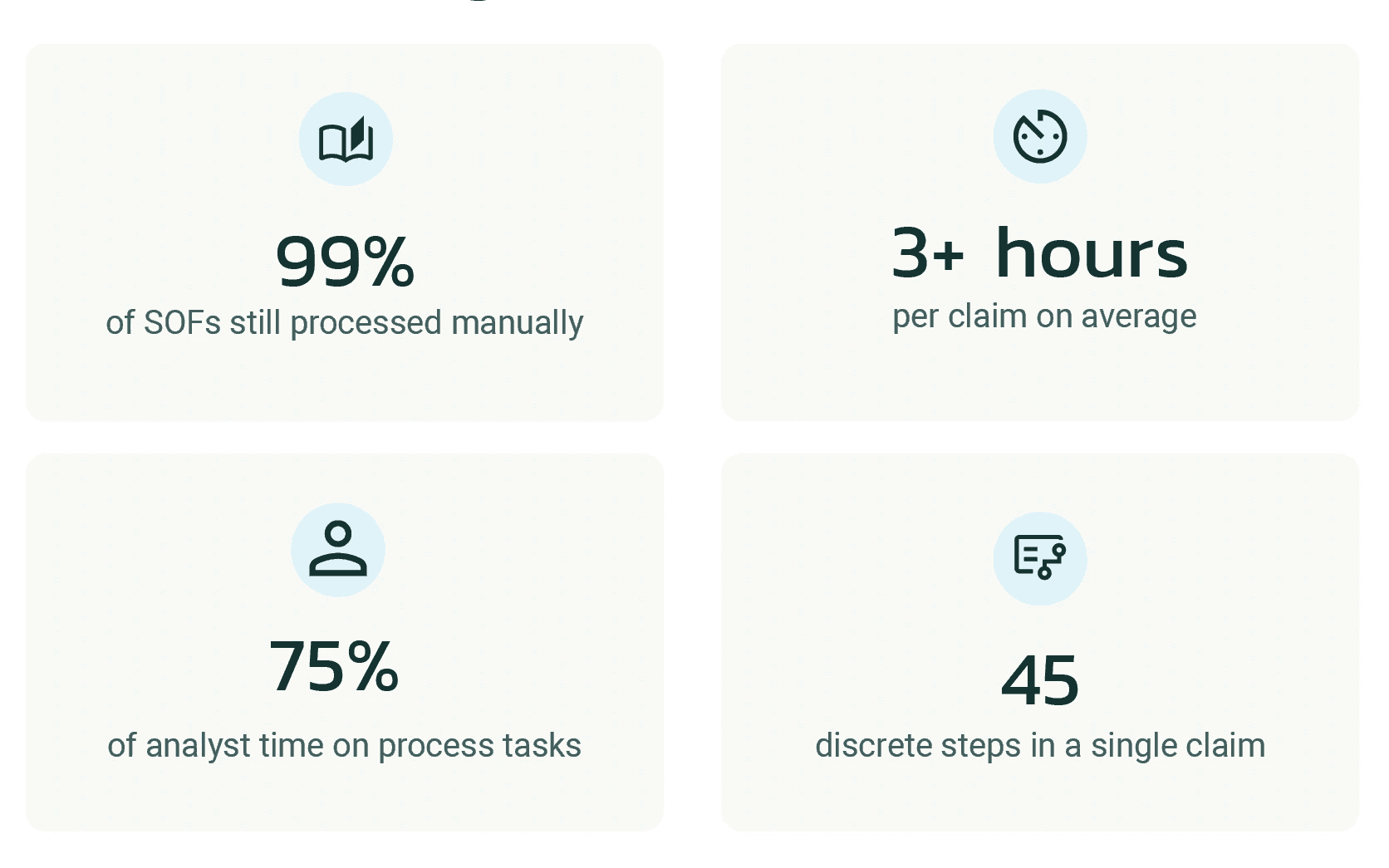
Around 99% of statements of facts are still processed by hand. Someone reads a PDF and types "all fast", "NOR + 6", a deduction or two.
A single claim averages three hours or more, and the people doing it are skilled analysts who know litigation history and can read a charter party; that expertise goes into data entry.
To save time they transcribe only the events the calculation needs, so the record of how the port call actually went is gone before anyone could use it. And a single missed operational detail in an SOF can carry $15,000 or more in exposure on one claim; miss a time bar because a document wasn't stamped and the claim is gone entirely.
One portfolio documented $450,000 in time-bar exposure on its own.
Demurrage software options: calculators, VMS, and specialist platforms
There are three categories of tool, and each stops at a different point.
Standalone laytime calculators give you the calculation and a laytime statement. Because they stand alone, they don't import data automatically or connect to accounts, trading, and credit-control systems.
Voyage management systems are broad platforms aimed primarily at shipowners managing chartering, operations, and demurrage. They cover a lot, but not demurrage in the depth a specialist does, and they tend to struggle with multiple charterers, transhipment, and the FOB-seller / CIF-buyer recovery problem that trading companies face.
Specialist laytime and demurrage platforms keep everything connected: time bars monitored, calculations and financials together, documents attached, all of it linked to the systems that already hold the data so nothing gets re-keyed. This is the category Marcura Claims sits in.
Where Marcura Claims fits, and what happened to HubSE
Marcura Claims is a laytime and demurrage management platform built for organisations processing claims at volume. HubSE, and its CMS product, is now part of Marcura Claims.
The laytime and demurrage capability you may know under the HubSE name now sits within Marcura's claims offering.
The data underneath it is what separates it from a calculator. SOFs arrive as PDFs, scanned, emailed, photographed, handwritten. OCR extracts the raw text, and a large language model trained on more than 600,000 SOFs interprets the event sequences across terminals and agents.
A specialist QA team reviews and corrects the output before it reaches the calculator. The result is normalised, structured event data with every event captured, not only the handful selected for a single calculation.
From claims processing to commercial intelligence
Once the process stops consuming the team, the same people produce a different kind of output.
A claims team already holds the knowledge of which counterparties to watch, which clauses create exposure, which ports carry the highest risk of disputed time.
With structured data behind them, that knowledge reaches the decisions where it pays in the forma of a powerful learning loop. The questions become answerable: what delays should we expect at this port, how many cents per tonne is demurrage costing, which clauses have cost us money.
One real example: a customer's holiday clause only gave relief for BIMCO holidays; a non-BIMCO port holiday left them carrying a day and a half on demurrage. The fix was one word, drop "BIMCO" from that clause at the next fixture.
That kind of recommendation comes from analysing the terms and the data together, which only works once the data is captured properly in the first place.
That's the case for moving off spreadsheets. The record they discard is the record your next negotiation depends on.
Are spreadsheets reliable enough for laytime and demurrage calculations?
Rarely at claim volume. Nine out of ten spreadsheets contain errors, and the standard demurrage setup, one sheet for the calculation and another to track the claim, validates nothing on entry and multiplies versions with every share. One missed detail can carry $15,000 or more in exposure on a single claim. Specialist software like Marcura Claims validates data on entry and keeps every claim in one shared record.
Can AI fully automate demurrage claims processing?
No. AI is strong on volume: reading statements of facts, extracting event sequences, flagging anomalies. It is weaker on the edge cases that decide claims, such as ambiguous clauses and conflicting documents. The approach that works pairs AI extraction with specialist review, which is why every AI-read SOF passes a QA team before it reaches the calculator. We've written more on where AI helps demurrage claims, and where it falls short.
How much does manual demurrage claims processing cost?
Start from three numbers: claims per year, analyst hours per claim, and the value of claims settled late or never pursued. A single claim averages three hours or more of skilled analyst time, and one missed operational detail in an SOF can carry $15,000 or more in exposure. Our claims ROI calculator runs the arithmetic for your own claim volumes.
What is a time bar in a demurrage claim?
A time bar is the contractual deadline for presenting a claim with complete supporting documentation. Miss it and the claim is gone, whatever its merit: one portfolio documented $450,000 in time-bar exposure on its own. Missed time bars are one of four patterns of demurrage leakage that recur in manual claims workflows.
Can demurrage claims data improve voyage estimates?
Yes, provided the data is captured as structured events rather than a handful of transcribed figures. Settled claims show which ports run over, which clauses cost money, and which counterparties dispute time. Fed back into estimates, that record prices port risk before the fixture instead of explaining it afterwards. We've covered how the claims-to-estimates learning loop works in practice.
Which cargo and claim types does Marcura Claims cover?
Laytime and demurrage across oil, chemicals and dry bulk, with chemical tanker depth added through the acquisition of specialist Shipdem. Through Fairway Maritime, Marcura also manages the complete claims process for shipowners, vessel pools, refiners and trading companies in the US and Europe, covering deviation, shifting, detention and other reimbursement claims alongside demurrage.
Are spreadsheets reliable enough for laytime and demurrage calculations?
Rarely at claim volume. Nine out of ten spreadsheets contain errors, and the standard demurrage setup, one sheet for the calculation and another to track the claim, validates nothing on entry and multiplies versions with every share. One missed detail can carry $15,000 or more in exposure on a single claim. Specialist software like Marcura Claims validates data on entry and keeps every claim in one shared record.
Can AI fully automate demurrage claims processing?
No. AI is strong on volume: reading statements of facts, extracting event sequences, flagging anomalies. It is weaker on the edge cases that decide claims, such as ambiguous clauses and conflicting documents. The approach that works pairs AI extraction with specialist review, which is why every AI-read SOF passes a QA team before it reaches the calculator. We've written more on where AI helps demurrage claims, and where it falls short.
How much does manual demurrage claims processing cost?
Start from three numbers: claims per year, analyst hours per claim, and the value of claims settled late or never pursued. A single claim averages three hours or more of skilled analyst time, and one missed operational detail in an SOF can carry $15,000 or more in exposure. Our claims ROI calculator runs the arithmetic for your own claim volumes.
What is a time bar in a demurrage claim?
A time bar is the contractual deadline for presenting a claim with complete supporting documentation. Miss it and the claim is gone, whatever its merit: one portfolio documented $450,000 in time-bar exposure on its own. Missed time bars are one of four patterns of demurrage leakage that recur in manual claims workflows.
Can demurrage claims data improve voyage estimates?
Yes, provided the data is captured as structured events rather than a handful of transcribed figures. Settled claims show which ports run over, which clauses cost money, and which counterparties dispute time. Fed back into estimates, that record prices port risk before the fixture instead of explaining it afterwards. We've covered how the claims-to-estimates learning loop works in practice.
Which cargo and claim types does Marcura Claims cover?
Laytime and demurrage across oil, chemicals and dry bulk, with chemical tanker depth added through the acquisition of specialist Shipdem. Through Fairway Maritime, Marcura also manages the complete claims process for shipowners, vessel pools, refiners and trading companies in the US and Europe, covering deviation, shifting, detention and other reimbursement claims alongside demurrage.
Are spreadsheets reliable enough for laytime and demurrage calculations?
Rarely at claim volume. Nine out of ten spreadsheets contain errors, and the standard demurrage setup, one sheet for the calculation and another to track the claim, validates nothing on entry and multiplies versions with every share. One missed detail can carry $15,000 or more in exposure on a single claim. Specialist software like Marcura Claims validates data on entry and keeps every claim in one shared record.
Can AI fully automate demurrage claims processing?
No. AI is strong on volume: reading statements of facts, extracting event sequences, flagging anomalies. It is weaker on the edge cases that decide claims, such as ambiguous clauses and conflicting documents. The approach that works pairs AI extraction with specialist review, which is why every AI-read SOF passes a QA team before it reaches the calculator. We've written more on where AI helps demurrage claims, and where it falls short.
How much does manual demurrage claims processing cost?
Start from three numbers: claims per year, analyst hours per claim, and the value of claims settled late or never pursued. A single claim averages three hours or more of skilled analyst time, and one missed operational detail in an SOF can carry $15,000 or more in exposure. Our claims ROI calculator runs the arithmetic for your own claim volumes.
What is a time bar in a demurrage claim?
A time bar is the contractual deadline for presenting a claim with complete supporting documentation. Miss it and the claim is gone, whatever its merit: one portfolio documented $450,000 in time-bar exposure on its own. Missed time bars are one of four patterns of demurrage leakage that recur in manual claims workflows.
Can demurrage claims data improve voyage estimates?
Yes, provided the data is captured as structured events rather than a handful of transcribed figures. Settled claims show which ports run over, which clauses cost money, and which counterparties dispute time. Fed back into estimates, that record prices port risk before the fixture instead of explaining it afterwards. We've covered how the claims-to-estimates learning loop works in practice.
Which cargo and claim types does Marcura Claims cover?
Laytime and demurrage across oil, chemicals and dry bulk, with chemical tanker depth added through the acquisition of specialist Shipdem. Through Fairway Maritime, Marcura also manages the complete claims process for shipowners, vessel pools, refiners and trading companies in the US and Europe, covering deviation, shifting, detention and other reimbursement claims alongside demurrage.
An earlier version of this article previously appeared in Trade Finance Global