STS flows shifted during the conflict. Will they shift back?
When the Strait of Hormuz closed, ship-to-ship oil transfers relocated fast. Gulf hubs fell 76% while the Gulf of Oman rose 71%. Marcura data on what happened, and what happens next

By Janani Yagnamurthy
SVP, Product, Strategic Growth
Is the shift in trade flows caused by the closure of the Strait of Hormuz a temporary adjustment or the start of something permanent? A week ago, it looked like we might be on the verge of finding out.
The US and Iran signed an interim agreement to end the fighting and reopen the Strait of Hormuz. The deal took effect Friday, and within hours the first tankers in 110 days began moving through a waterway that had been effectively sealed since February. The recalibration, it seemed, was underway.
Like many things in this conflict, things then changed quickly.
On Saturday Iran declared the Strait closed again, citing Israeli strikes in southern Lebanon as a breach of the ceasefire, and its Revolutionary Guard warned vessels away from the channel. Washington disputes the claim.
US Central Command says the Strait stayed open, with 55 merchant ships moving more than 17 million barrels through it on Saturday alone. Independent sources paint a mixed picture. Transits snapped back sharply on Friday, sank over the weekend, before a slight rebound at the start of the week.
The question for tanker operators isn't necessarily geopolitical. The deal holding or breaking is largely out of their hands. The decision they face is where to commit tonnage while both outcomes are still in play, and whether to treat the relocations of the last four months as a temporary detour or the new map.

What the Strait of Hormuz Teaches About Charter Party Risk
By connecting claims experience, operational data and contractual insight, shipping companies are beginning to move from reacting to disputes to anticipating charter party risk before voyages begin
Where did STS flows go when the Strait of Hormuz closed?
Data compiled by Marcura tracking ship-to-ship (STS) transfers across the region suggests the answer is more complicated than any single headline.
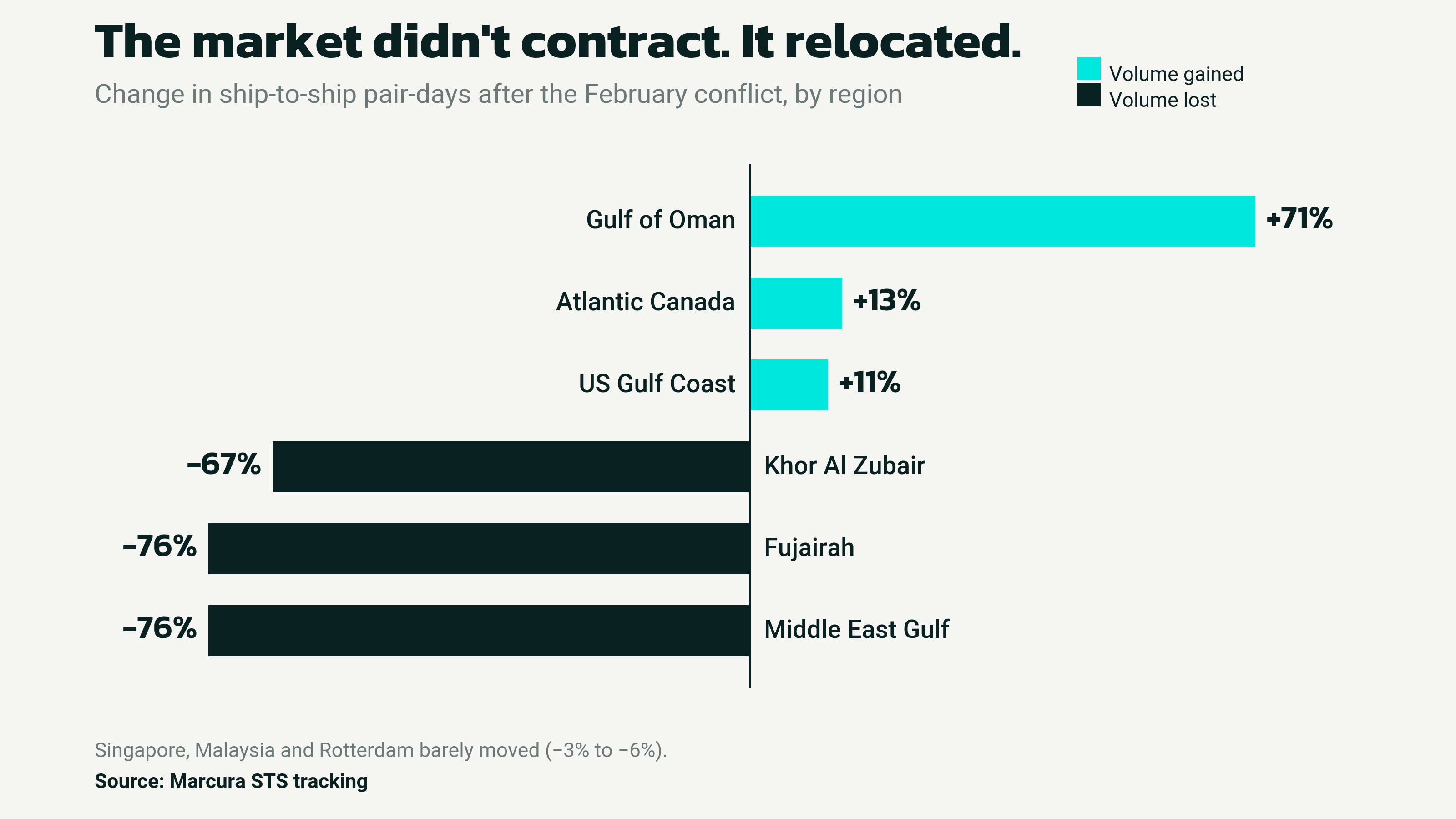
Following the February conflict, STS activity at traditional Gulf hubs collapsed in volume terms. The Middle East Gulf overall fell from by 76% reduction with STS activity in Fujairah dropping by the same margin. Khor Al Zubair was down 67%.
But global STS volumes held. The Gulf of Oman absorbed much of the immediate displacement, rising 71% over the period.
The US Gulf Coast grew 11%. Atlantic Canada was up 13%. Singapore, Malaysia, and Rotterdam barely moved, each registering falls of between 3% and 6%. The market didn't contract. It relocated, and it did so quickly.
Will STS flows shift back to the Gulf?
With an MOU now signed, if not yet secure, will some of that relocation unwind? Confidence in Gulf zones should return gradually, and volumes will follow. But the weekend is a reminder of how conditional that recovery is.
Infrastructure damage means any rebound will be uneven, and a Strait that can be declared closed at the drop of a hat is not one operators will reposition tonnage around with confidence. Facilities taken offline don't restart overnight, and the cargo volumes tied to them won't either.
The most useful question, then, isn't whether Fujairah returns to pre-conflict levels. It's which of these relocations prove temporary, which ones stick, and what that means for tonnage positioning over the next twelve months.
The MOU is signed. The Strait remains contested. The market recalibration is off to a stuttering start.
The question for tanker operators isn't necessarily geopolitical. The deal holding or breaking is largely out of their hands. The decision they face is where to commit tonnage while both outcomes are still in play, and whether to treat the relocations of the last four months as a temporary detour or the new map.
Marcura's Charter Party Optimiser delivers full-document contract review in six minutes. But speed tells only part of the story. The real value emerges from analysis that simply wouldn't happen manually.
How AI Risk Analysis Changes Charter Party Negotiations