In this report
Where analyst time goes: Why most analyst time goes to process tasks that don’t require their expertise, and what that costs the portfolio.
Four points of leakage: The four structural points where recoverable entitlement goes unclaimed: calculation errors, slow reporting, missed time bars and key-person risk.
The cost of ambiguous clauses: How ambiguous or incomplete charter party terms lead to write-downs and delay claim submission.
Claims data as intelligence: How structured claims data reveals demurrage trends, port performance, costly clauses and counterparty patterns.
Into the next fixture: How claims outcomes feed voyage estimates and berth order, and change the negotiation dynamic with counterparties.
Marcura Claims' 2026 guide, Demurrage Management: From Claims Processing to Commercial Intelligence, argues that laytime and demurrage claims data holds the answers the business needs. Those answers include why demurrage is incurred, where it concentrates and which charter party clauses to fix. Fragmented, manual workflows keep them locked inside each claim. The guide draws on the more than 20,000 claims Marcura processes a year.
What is demurrage management?
In our definition, demurrage management is the work of running laytime and demurrage claims from port call to settlement. It also means putting what those claims reveal to commercial use. In our terms, in voyage chartering, demurrage is the amount payable when loading or discharge overruns the laytime the charter party allows. Container demurrage and detention is a separate subject. Marcura Claims’ 2026 guide gives one market estimate: dry bulk alone sees $8–10 billion in demurrage fees a year, roughly 6–8% of total freight spend.
Not all of that is within a claims team’s reach. Port congestion, weather and terminal delays are genuine operational realities, the authors note, and part of demurrage exposure flows from conditions no team can control. But they argue that a meaningful share also stems from how claims are managed after the vessel sails. Telling the two apart, the authors say, depends on data the current process rarely produces.
Where does the time in a demurrage claim go?
According to Marcura’s demurrage management guide, most analyst time in demurrage claims management goes on process tasks rather than expert judgement. A single claim involves roughly 45 discrete steps, most of them process tasks such as document collection, data entry, chasing, formatting and filing. The guide says analysis shows roughly 75% of analyst time is absorbed by process tasks. High-value work, including analysis, dispute handling, clause interpretation and negotiation, “becomes a footnote”. A separate indicator gives 3+ hours per claim on average, without saying what that time covers.
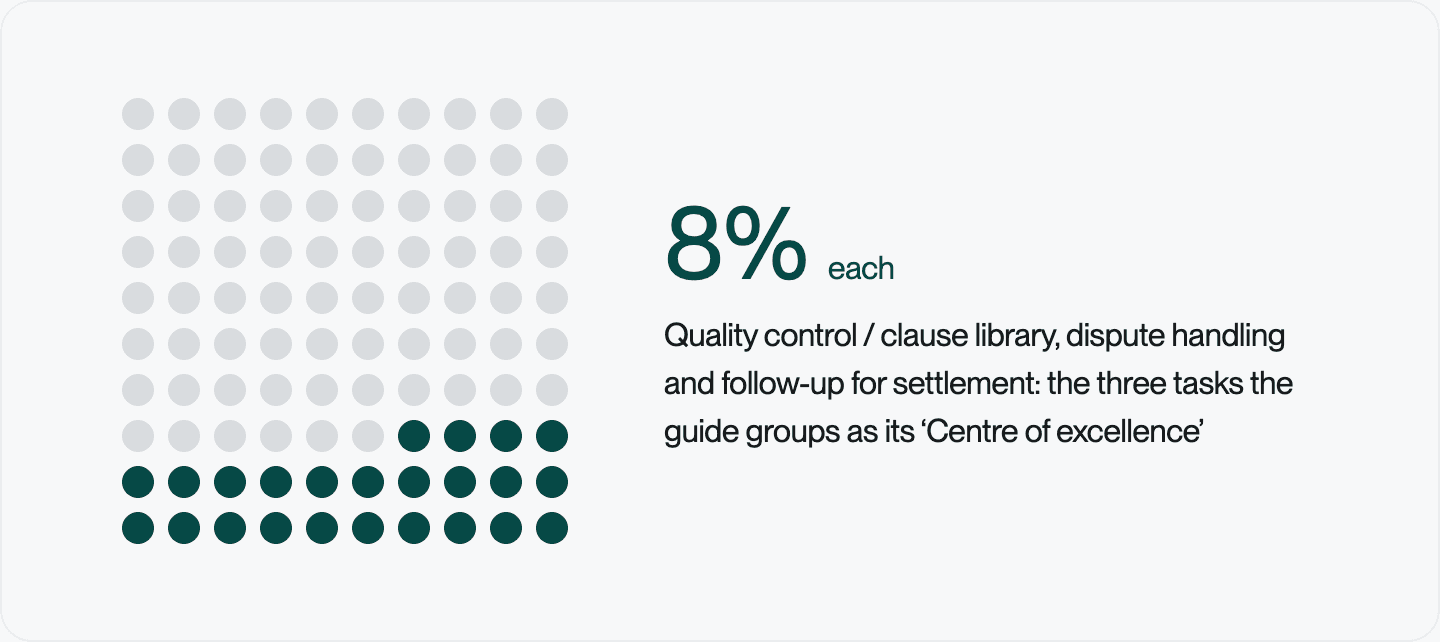
Exhibit 1: The three tasks the guide groups as its "Centre of excellence" are the smallest in its breakdown of laytime claims management, at 8% each. Values as printed. Source: Marcura Claims, Demurrage Management guide (2026).
In the guide’s breakdown, collecting, sorting and compiling documents accounts for 21%, solving incomplete documents 13% and reading and entering charter party terms into the calculator 12%. Checking and verifying documents, statement of facts (SOF) entry into the calculator, and sending and following up with the counterparty for receipt account for 10% each. The three tasks grouped as the “Centre of excellence”, quality control / clause library, dispute handling and follow-up for settlement, account for 8% each.
Where claims team capacity goes
A meaningful share of a demurrage claims team’s capacity goes on process work, not the analysis and negotiation it was built for, Marcura’s guide argues. By the typical industry benchmarks it cites, a grains shipowner runs 16–20 full-time equivalents (FTE) on claims, a tanker operator 13 and a charterer 15. The process work it names is SOF transcription, document chasing and manual tracking of time bars (in our terms, the deadlines for presenting a claim).
How do manual workflows leave recoverable demurrage unclaimed?
Marcura’s demurrage management guide identifies four structural points where manual workflows leave recoverable entitlement unclaimed. It says the same patterns recur across organisations of every size and commodity type. They are summarised below, and our article on where demurrage actually gets lost covers each one in depth.
The guide's four points where recoverable entitlement goes unclaimed
Leakage point | What goes wrong |
|---|---|
Rates and calculations | Errors and skipped deductions under time pressure |
Time bars | A missed time bar ends the claim |
Reporting | Leadership questions become multi-week projects |
Key-person risk | Counterparty, clause and decision history leaves with the analyst |
Two figures in the guide illustrate the first two points. At the demurrage rates it cites, $15,000–30,000 a day, each unrecovered detail compounds across a portfolio. On time bars, one portfolio it cites documented $450,000 in time bar failures in a single year.
Which charter party clauses drive demurrage write-downs?
Beyond the administrative burden, Marcura’s demurrage management guide identifies a second, less discussed category of leakage: ambiguous, incomplete or silent charter party terms. It puts charter party ambiguity at 5–10% of total demurrage write-downs across the industry, and says ambiguity can delay claim submission by 20–30 days. The authors list typical causes. Traders add rider clauses in email threads. Holiday clauses reference only BIMCO-defined holidays. Ship-to-ship (STS) clauses miss laytime start and end details, and early loading clauses use ambiguous language around laycan.
The authors approximate the impact of four such clause problems at between about $7,000 and about $70,000 per port call. They give no vessel size, rate or port behind those figures, and present them as approximations.
Four clause problems and their approximate impact per port call, as the guide gives them
Clause | What is wrong | Impact |
|---|---|---|
Daylight and documentation | Silent on daylight restrictions; no documentation clause applied | ~$7,000 |
Early loading (ambiguous) | Laytime may only commence from agreed laycan, even if loading begins earlier | ~$70,000 |
Vessel on demurrage (incomplete) | Daylight restrictions not excluded once on demurrage | ~$20,000 |
STS (missing details) | Laytime start and end details absent | ~$20,000 |
For a worked case of clauses pulling against each other, see charter party clause contradictions driving demurrage claims.
The holiday clause that needed one word changed
In the guide’s one worked example, a holiday clause that referenced only BIMCO holidays left a charterer owing a day and a half of demurrage. The vessel called at a port observing a local public holiday not on the BIMCO list, time the clause should have covered. The fix on renewal was one word: remove “BIMCO”, so any recognised holiday is excluded from laytime. Finding the problem meant cross-referencing operational data against the clause. Without structured data, the authors argue, that connection either never gets made or takes weeks to surface.
What can demurrage claims data tell you?
Marcura’s demurrage management guide argues that demurrage claims data shows why demurrage is incurred, where it concentrates and which clauses to fix. The claims team already holds that insight, the authors say, and the rest of the business needs it. Describing Marcura’s own process, the guide says that because every SOF event is captured and normalised, “reporting becomes a query rather than a project”. It lists four categories of insight that then become available.
Four categories of intelligence the guide lists as available from Marcura's own captured SOF data
Category | What it shows |
|---|---|
Demurrage and despatch trends | Visibility across the portfolio |
Port performance | Terminals and activities that drive outliers |
Clause analysis | Costly terms to renegotiate |
Counterparty performance | Negotiation patterns and leverage |
Why that insight stays buried
According to Marcura’s guide, fragmented, manual workflows bury that intelligence inside the claim. It describes claims living across disconnected spreadsheets, with operational detail staying on SOFs rather than in systems. Knowledge about counterparties, clause history and port behaviour sits with individual analysts rather than in a shared record. Most claims teams, the authors argue, use tools never designed for today’s volume or complexity. “All of this is not a failure of capability,” they write. “It is what the current tools make possible.” Our comparison of demurrage spreadsheets and software looks at what that costs.
How counterparty data changes the negotiation
In the same section on Marcura’s own reporting, the guide singles out counterparty performance as the category of demurrage claims data that “changes the negotiation dynamic directly”, and points to two things. When a counterparty knows your claims are consistently accurate, the cycle shortens. The data can also show how that counterparty has behaved across a broad population of claims. That gives the analyst entering the negotiation “an edge no individual team’s memory can replicate”.
The guide makes a similar point about clauses: structured claims data “tells you which clauses have historically cost you and what changes are worth pushing for at the next negotiation”, the authors write.
Can AI automate demurrage claims?
Not on its own, according to Marcura’s demurrage management guide. Its note on AI, which sits in the chapter on how Marcura Claims works, says document quality, scan angle and handwriting legibility all affect what a language model produces. It explains that Marcura’s quality-assurance layer exists “because automation alone is not sufficient”. Among teams using AI-only claims tools, the authors observe, “the workload does not disappear, it relocates”. Someone is still chasing the stamped original, filling data gaps and handling the exceptions the algorithm flagged but could not resolve. The best outcomes, they conclude, combine automation with expert review so outputs are accurate and defensible.
For the claims process step by step, see how demurrage claims software works. For the case for specialists alongside automation, see why maritime claims needs a human in the loop.
How can claims outcomes inform voyage estimates and fixtures?
Marcura’s demurrage management guide argues that claims outcomes can inform voyage estimates. Describing Marcura’s own learning loop, it says claims outcomes feed the port performance data that chartering teams use to estimate voyage costs and berth order. Their models are then informed by deterministic outcomes from real claims rather than industry averages. Clause patterns, in turn, inform the next fixture negotiation. The claims team’s work, the authors write, “feeds forward into commercial decisions it would otherwise never reach”.
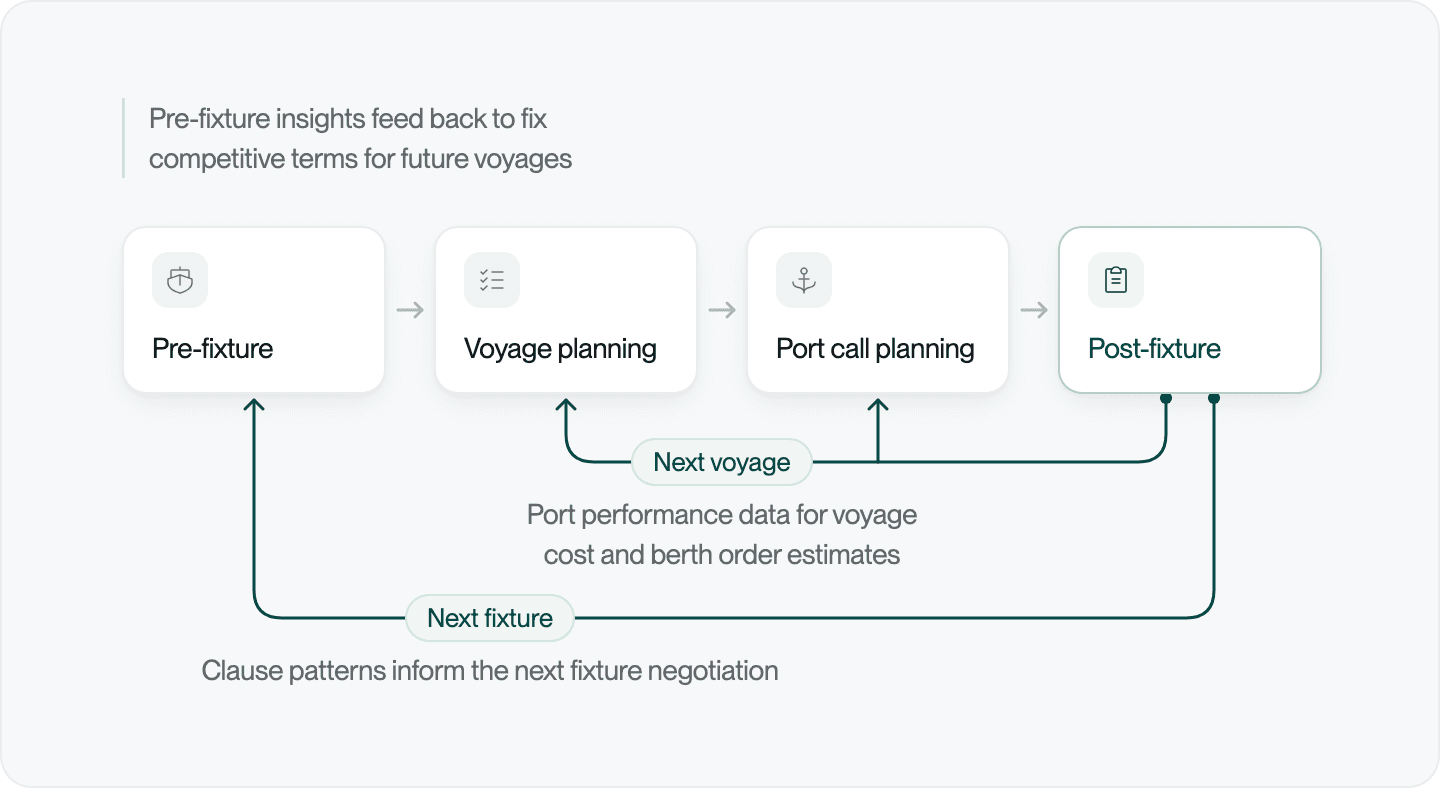
Exhibit 2: The learning loop. Claims outcomes captured after the fixture feed port performance data and clause patterns back into voyage planning and the next fixture. Adapted and simplified from the guide's learning-loop diagram and text; arrows, labels and layout are ours, without product names. Source: Marcura Claims, Demurrage Management guide (2026).
The loop runs through four stages: pre-fixture, voyage planning, port call planning and post-fixture. Claims outcomes captured after the fixture flow back into planning, and pre-fixture insights feed back to fix competitive terms for future voyages. Our article on using claims data to sharpen future voyage estimates goes deeper.
In the same learning-loop chapter, the authors name the logical next step as charter party risk analysis: using accumulated claims patterns to review new charter parties before they are signed. That means flagging clause types that have historically generated disputes and quantifying the exposure in advance. For more on the subject, see how AI risk analysis changes charter party negotiations and what the Strait of Hormuz teaches about charter party risk.
Where should a claims team start?
With the statement of facts, according to Marcura’s demurrage management guide. Its closing argument is that the claims team already holds what the business needs. That means knowing which counterparties to watch, which clauses create exposure and which ports carry the highest risk of disputed time. The authors are clear about what they are not proposing. “The goal is not to automate the claims function. The goal is to stop burying expertise under tasks that should not require it and to focus expertise on decisions that drive commercial impact.”

About this guide
Demurrage Management: From Claims Processing to Commercial Intelligence is a 15-page guide published by Marcura Claims in 2026. It names no individual authors and gives no publication month. It draws on Marcura’s experience processing more than 20,000 claims a year across dry bulk, tankers, chemicals and project cargo.
It is a guide, not a survey, and publishes no sample or respondent data. It gives no sources or bases for its industry figures: the dry bulk market estimate, day rates, team benchmarks, write-down share and clause impacts. Nor does it state the method behind its figures for steps per claim, hours per claim and the split of analyst time. This article attributes those figures to the guide and reports them as printed. It defines neither demurrage nor demurrage management, so both definitions above are ours, as is the short gloss of a time bar.
The guide’s later chapters describe how Marcura Claims works. This summary leaves out most product features, the published-outcomes list and the customer testimonial; where it draws on those chapters, it says so. For that, see Marcura’s demurrage claims service.
FAQs
Related resources