










Typical gap between proforma and final disbursement accounts
Of husbandry workflows still managed through fragmented email chains
Benchmarks available to most teams when committing to an agent
The question owners and managers can't answer
Around 195,000 non-commercial port calls take place annually. The costs flowing through each of them are fragmented across ports, agents, and invoices. All processed through manual, time-pressured workflows.
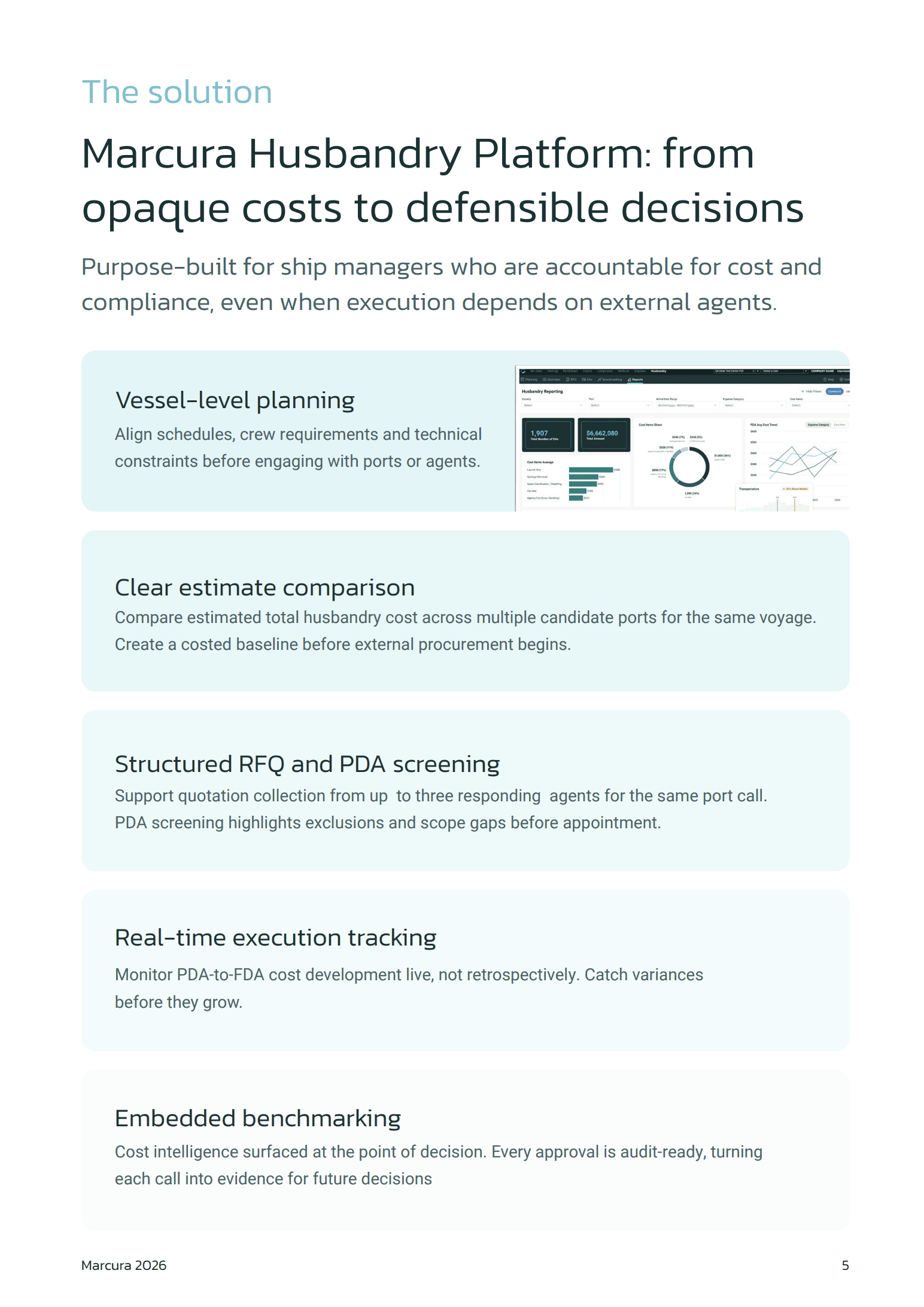
The core problem is the absence of structured, comparable data at the moment decisions are made. Service definitions vary between agents. Scope is rarely defined before agents are engaged. There is no reliable market benchmark when committing to a PDA. And by the time the FDA lands, the opportunity to influence cost has already passed.
What's in the guide
Why owners can't verify their costs are fair, and why managers can't prove they are.
What changes when cost data enters the process before you commit, not after the FDA arrives
How one bulker fleet operator moved from fragmented email workflows to full cash flow control
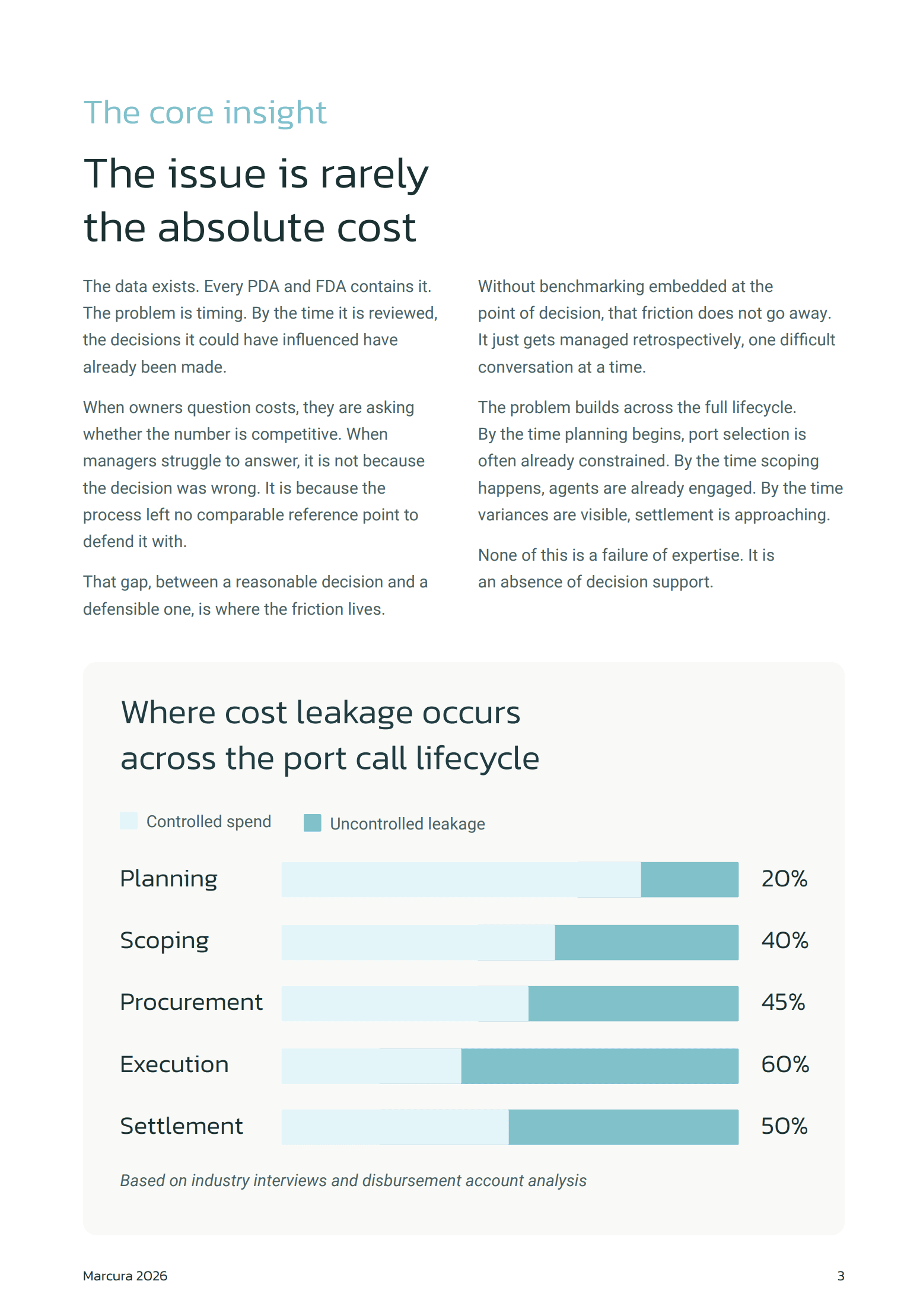
Where costs leak across the port call lifecycle, and at which point it's too late to act
How to have a benchmark in hand before you approve a PDA, not after the damage is done
“The main impact was on the manual effort required by the team. We also have better control of cash flow, so there’s no need to pre-fund managers for payments. And the scope management between departments is much clearer.”
Bulker fleet operator, Marcura customer
Get more insight from our team
of husbandry experts

How do you get comparable quotes from multiple port agents for the same port call?
Most teams can't. Quotes arrive in different formats, via email, with different service definitions that make side-by-side comparison impossible.
A structured RFQ process standardises what agents quote against: the same scope, the same service line items, the same format. That makes comparison possible before the appointment is made, rather than after the FDA arrives and the spend has already happened.
How do I know if my port agent is overcharging?
Without a benchmark for what a husbandry port call should cost at a given port, for a given vessel type, the PDA either gets approved on instinct or challenged without any data to back it up. Typical PDA-to-FDA variance runs at 3× across the industry.
The practical answer is comparison data: historical spend at that port, quotes from multiple agents in a standardised format, and a market benchmark surfaced at the moment of PDA review, not pulled from a separate tool after the fact.
How can ship managers reduce PDA-to-FDA variance across a fleet?
PDA-to-FDA variance concentrates at specific points in the port call lifecycle where decisions are made without the context to make them well. Variance reduces when benchmark data enters the process before commitments are made: at PDA approval, not at FDA review.
How do you audit a final disbursement account in shipping?
FDA auditing typically happens manually: someone on the back-office team checks line items against the PDA, flags anomalies, and follows up with the agent on discrepancies. The problem is that this catches obvious errors but misses overcharging that sits within the range of what looks plausible — agency fees above contracted rates, anchorage costs slightly inflated, launch hire charges that don't match the port profile.
A systematic audit cross-references each line against contracted rates for that agent, benchmark data for that port and service type, and historical spend for that vessel. That combination catches the leakage that manual review normalises.
How do ship managers benchmark port agent quotes without access to market data?
Most operators can't answer questions like "how much should I pay for launch hire per nautical mile at this port?" because that data doesn't exist internally unless you've processed thousands of DAs at the same ports.
Meaningful benchmarking requires historical spend data across many operators, vessel types, and port profiles, which is why it's typically only available through platforms that sit across the wider DA ecosystem rather than within any single operation.