In this report
The two bosses problem: Why different reporting lines for procurement and finance create a structural control gap, and why that’s a problem.
Five places exposure accumulates: A directional cost model showing how small accepted variances compound across a fleet.
Four scenarios where AP breaks: Where standard maritime AP workflows break down: partial deliveries, vessel-side discrepancies, fleet-wide service agreements and hard-to-catch duplicates.
Two things for Monday’s meeting: A workflow audit table and KPI scorecard to assess your current processes and build your business case for change.
The Maritime Control Gap is Marcura's guide to maritime invoice control between procurement and payment. Its argument is that maritime has digitised the purchase order, but control over the invoice has not kept pace. Once the invoice arrives, the checks that follow are split across procurement, operations and finance, and often move into spreadsheets, inboxes and email.
Key points from the guide
Procurement went digital; invoice control was left behind. Matching often happens in spreadsheets and shared inboxes, and delivery confirmations are chased by email.
Tolerance was a rational choice. Resolving a small discrepancy often cost more than it recovered, so thresholds kept invoices moving.
Checking is structurally hard, and it spans three teams. Procurement, operations and finance each own one part, so matching spans all three.
Exposure builds in five places. Manual effort, system fragmentation, a real workflow that often sits outside the enterprise resource planning (ERP) system, discrepancies invisible at scale and fragmented compliance.
Standard matching struggles with everyday maritime cases. Four scenarios show where, from a short delivery found after payment to a fleet-wide invoice that bills vessels outside the contract.
Start with your own process. The guide’s audit table and key performance indicator (KPI) scorecard are meant to be completed internally, before any vendor conversation.
Why does maritime invoice control break down between procurement and payment?
Maritime invoice control is the set of checks between a supplier’s invoice arriving and the supplier being paid. It covers capturing the invoice and matching it against the purchase order (PO), goods receipt and vessel confirmation. It also covers resolving variances, running compliance checks and releasing payment. In the guide’s argument, that control breaks down because the structure built around the PO largely disappears once the invoice arrives.
The guide says maritime has spent a decade moving the buying half of the process onto supplier networks, procurement platforms and e-procurement workflows. By the time a PO is issued, the supplier is vetted, the price agreed and the order tracked in a system built for it. Then, in the guide’s words, “when the invoice arrives, much of that structure disappears.” Our article on why digitised procurement left invoice control behind sets out that argument in full.
Matching then often happens in spreadsheets, shared inboxes or ERP workflows never designed for vessel-specific exceptions. Variances are resolved through disconnected conversations between procurement, operations, suppliers and finance. For many ship managers and operators, the foreword says, the most important financial control decisions in procure-to-pay “still happen outside the system of record”.
That work is often invisible. In one internal review described in the foreword, a ship management company analysed its own process. Between 15 and 20 per cent of ship superintendent and fleet manager time went on invoice-related activity. Almost none of that time registered in the finance system. It sat in email threads with suppliers and in vessel confirmation requests that could take days to resolve. This is a single review, and the company is not named.
Why did tolerance become normal in maritime invoice control?
The guide argues that tolerance thresholds became normal in maritime accounts payable (AP) because resolving a small discrepancy often cost more than it recovered. Our article on AP tolerance thresholds looks at what those accepted variances add up to.
The pressure starts with headcount. The guide argues that, for most ship managers and operators, invoice workload scales almost perfectly with fleet growth. Every vessel added brings more invoices, exceptions, supplier correspondence and vessel confirmation requests, but AP headcount rarely grows at the same rate. Finance teams then face a structural choice: add staff, or process invoices with less scrutiny to keep them moving.
The guide gives an example of how many steps resolving a discrepancy can take. A five per cent variance on a relatively small invoice may be only a minor financial exposure. Investigating it can still need vessel confirmation, a supplier query, internal escalation, credit note management and approval rework. When that costs more than the value recovered, a tolerance threshold became, in the guide’s account, the practical answer.
The catch, in the guide’s words, is that “small variances compound at fleet scale”. What looks insignificant on one invoice can become material across thousands of transactions a year. In the guide’s argument, the calculation behind tolerance changes once extraction is automated, matching continuous, compliance embedded, payment workflows connected and exception handling visible. When the cost of checking falls, the guide says, the case for fragmented tolerance-based workflows weakens with it.
Why is checking a maritime invoice structurally hard?
Checking a maritime invoice is hard because the evidence needed to approve it is spread across documents, shipments, the vessel and separate systems. The guide calls the cost of checking in maritime AP “structural”, and describes these features:
Documents: invoices arrive as scanned PDFs or multi-page technical documents, often with items described in supplier-specific terms the ERP does not recognise
Shipments: one purchase order for engine spares may arrive in three shipments over six weeks, each with its own invoice
The vessel: confirming that goods arrived needs input from a ship that may have limited connectivity and a crew whose time is committed elsewhere
Systems: procurement, operations and finance often work in different systems with limited workflow integration between them
Validating one invoice therefore often means rebuilding the operational context by hand across several teams and channels. The guide says that for years, experience, manual coordination and tolerance-based workflows absorbed that work. As fleets grow and invoice volumes rise, the limits of that model become more visible.
Why does invoice matching span three teams in maritime?
In the guide’s account, invoice matching in maritime spans procurement, operations and finance because each team owns a different part of the process. The guide says that in many industries, procurement and finance share a reporting structure. Maritime often works differently. Procurement typically sits closer to operations, because purchasing decisions start with technical managers, superintendents and vessel requirements. Finance enters later, at the invoice and payment stage.
The result is a procure-to-pay process split three ways. Procurement owns the supplier and the purchase order. Operations own “delivery reality”. Finance owns invoice approval and payment. Matching, in the guide’s phrase, “becomes a control function spanning all three”.
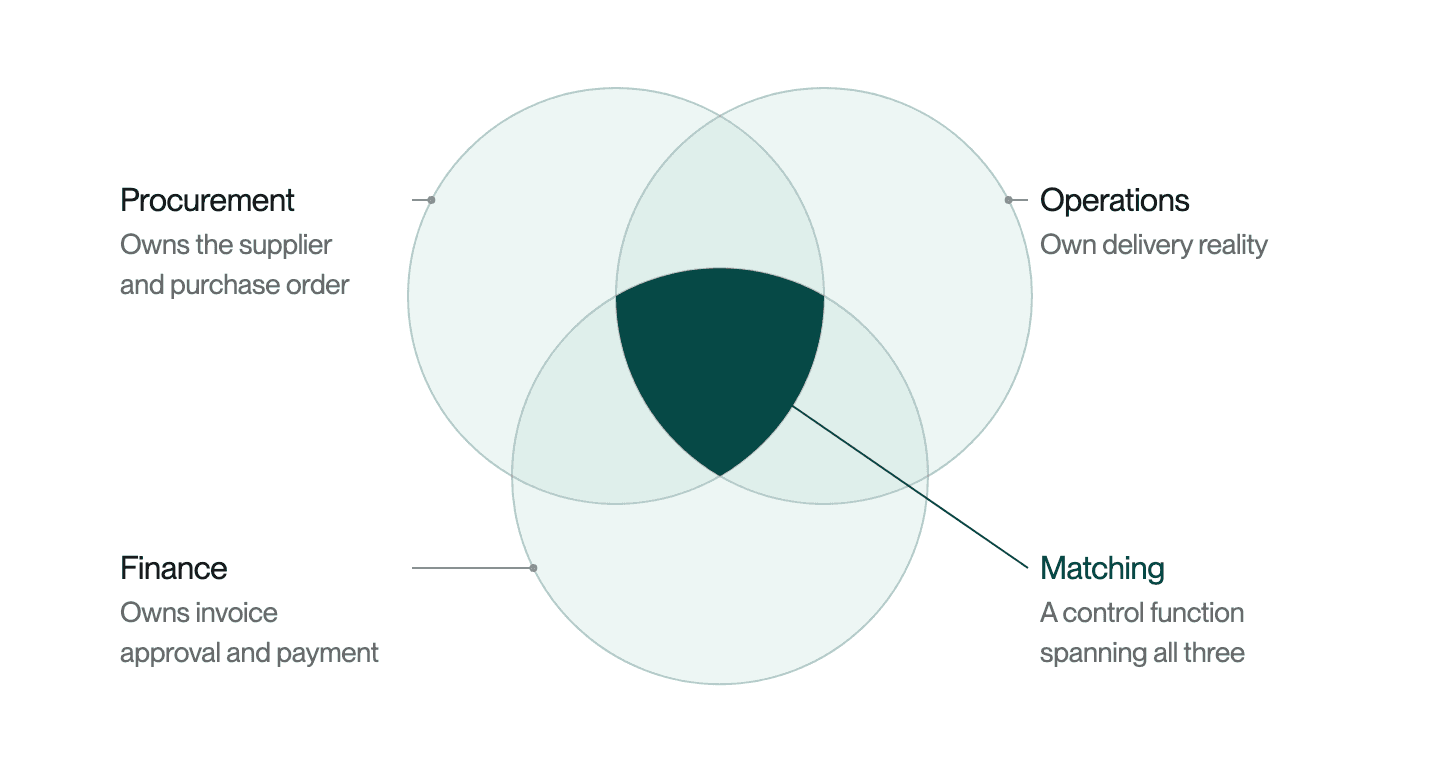
Exhibit 1: Procurement, operations and finance each own part of procure-to-pay, so matching spans all three. Source: The Maritime Control Gap, Marcura.
The guide adds that, in practice, the information needed to validate an invoice often sits across disconnected systems, inboxes and teams rather than in one workflow, and that this fragmentation is where financial exposure accumulates.
What are the six stages from invoice to payment?
In the guide’s model, six stages run from an invoice arriving to the supplier being paid. They are ingest, extract, match, manage variance, enforce compliance and execute payment, and they frame the process audit below.
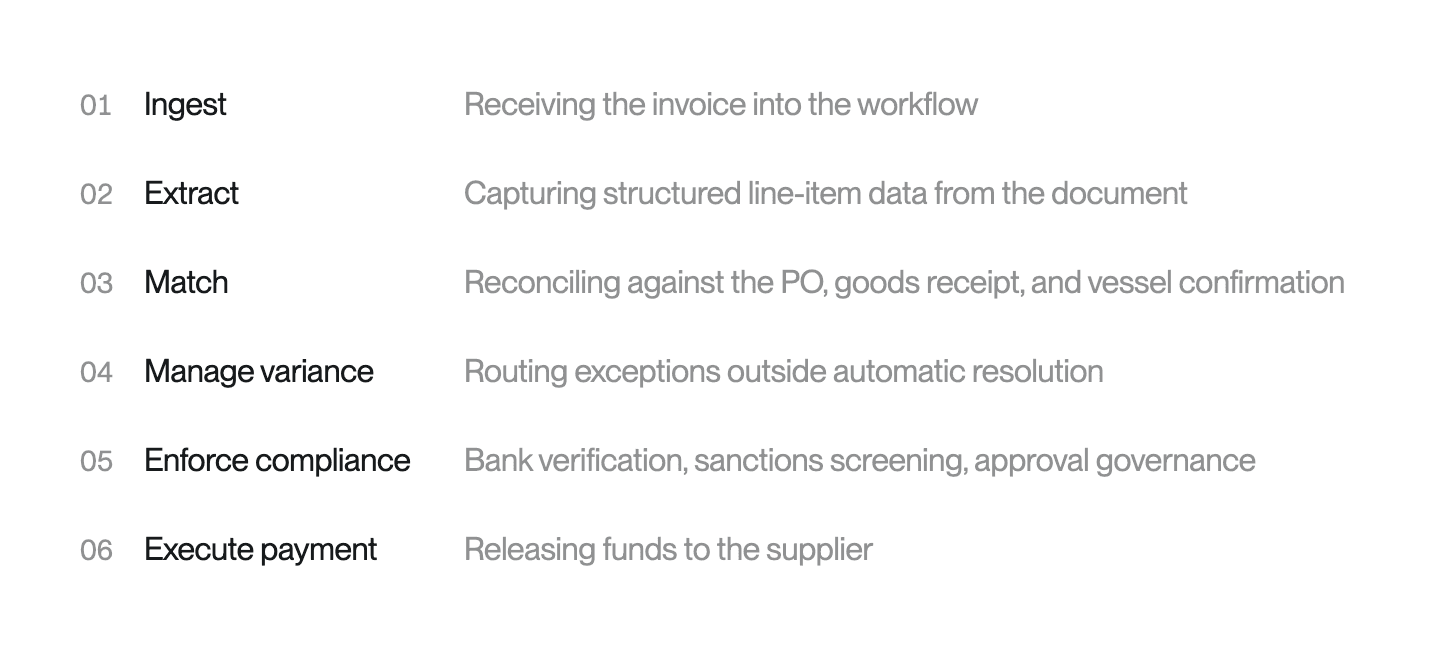
Exhibit 2: Six stages from invoice to payment. Source: The Maritime Control Gap, Marcura.
Where does financial exposure accumulate in maritime AP?
According to the guide, exposure in maritime AP usually accumulates gradually, through small events that each look manageable. A discrepancy is accepted within tolerance. A duplicate invoice is processed through a different entity. A payment query takes days to reconstruct. Across thousands of invoices and several workflows, these events become a control burden. It names five places where that exposure builds.
Manual effort per invoice
The guide says many maritime invoices do not clear on first review, and each exception creates manual coordination. A delivery may still need vessel confirmation. A supplier’s description may not match the PO, or a partial shipment may produce several invoices against one order. Each exception brings supplier correspondence, vessel follow-up and rework, and the workload grows in proportion to the fleet. Without more automation, invoice handling scales mainly through more staff effort or less review depth. For what that handling costs, read the hidden cost of manual invoice processing in ship management.
System fragmentation and the consolidation imperative
In the guide’s account, maritime AP often runs across disconnected systems: procurement platforms, maritime ERPs, compliance tools, email, banking platforms and spreadsheets. Information moves between them through re-keyed fields, CSV exports, email approvals and copied payment data. No single workflow holds the full operational history behind an invoice. Tracing a payment back to its purchase order can mean rebuilding the trail by hand across systems and teams.
The real workflow often exists outside the ERP
In many maritime organisations, the guide says, the working AP process exists mainly in email. Exceptions are handled in inboxes, approval requests are forwarded by hand, and supplier discrepancies are resolved in correspondence between AP teams, procurement, superintendents and vessels. The ERP may record the final posted transaction while the decisions behind it live elsewhere. That leaves two parallel workflows, which we look at in the two AP workflows running in every maritime organisation.
Small discrepancies become invisible at scale
Many duplicate controls are designed around purchase orders, but maritime operational spend does not always follow a PO. Engaging a port agent, for example, has not traditionally required one as standard. Without a PO anchor, the duplicate check becomes manual. Someone has to recognise that this supplier, for this port call, on this vessel, has already been paid. Tolerance policies, meanwhile, can let repeated small discrepancies pass unchallenged, because no single invoice looks material enough to investigate. The issue, in the guide’s words, “is not usually a single large failure”.
Fragmented compliance and fraud exposure
According to the guide, compliance checks in many AP environments run around the payment process rather than inside it. Vendor onboarding may happen months before payment, bank details may be verified once rather than continuously, and sanctions checks may run separately from invoice approval. That leaves gaps between invoice approval, supplier validation and payment release. Fraud risk rises in those gaps, particularly when supplier bank account changes arrive through email-based workflows. Our article on supplier bank account fraud in maritime AP follows how that plays out.
Where do standard AP workflows break down in maritime?
Standard AP workflows break down at maritime’s operational edges. The guide lists them as partial deliveries, vessel-side discrepancies, fleet-wide service agreements, multi-entity procurement structures and high line-count invoices. These situations are normal in maritime but hard for standard workflows to process cleanly. The guide’s four scenarios, based on “recurring patterns encountered by ship managers and operators”, show where matching begins to struggle. They are illustrations and name no customers.
Short delivery found after payment
An invoice can be paid before the vessel confirms what arrived. In the guide’s example, a deck stores delivery is signed for at the berth, and the matching invoice is paid. The stores inventory at sea later finds three lines short. In the guide’s resolution, when the vessel’s receipt is part of matching, the invoice waits for it, so the three short lines are flagged before payment. More in our article on four-way matching.
A duplicate invoice with no purchase order, paid twice
A corrected invoice with no purchase order can be paid twice when duplicate detection relies on document reference and PO number. In the example, a port agent provides husbandry services for a vessel at Rotterdam. The agent reissues a corrected invoice without formally cancelling the original. Both versions reach AP weeks apart, neither has a PO, and standard detection sees two different references and passes both.
In the guide’s resolution, duplicate detection built for maritime spend matches on supplier, vessel, port and service date, not document reference alone. It treats invoices without a PO as a normal category of spend. The second invoice is flagged before payment because the event it describes has already been paid.
A provisions invoice too long to check by hand
A provisions invoice can run to more lines than a normal AP cycle can check by hand. In the guide’s example, a ship chandler invoices a tanker’s provisions order with 214 line items, from fresh produce to galley consumables. Reviewing an invoice at that line count by hand is not realistic within a normal AP cycle. Some lines may sit outside tolerance, and the difference may stay invisible until month-end reconciliation, if it surfaces at all.
In the guide’s resolution, AI-assisted extraction maps each line to its most probable PO line and assigns a confidence score. High-confidence lines within tolerance flow through. The lines that cannot be resolved go to a reviewer with the reason for each flag. Examples include a quantity that does not match the vessel’s confirmed delivery, or a unit price above the chandler’s agreed rate schedule. In the guide’s example, the AP team reviews 17 lines rather than all 214.
A fleet-wide invoice that bills vessels outside the contract
A fleet-wide service invoice can bill for vessels the contract does not cover and still be paid. In the example, a ship manager with 200 vessels signs a fleet-wide internet connectivity agreement, invoiced monthly with one line per vessel. The invoice arrives with 210 lines, ten of them for vessels the agreement does not cover. The total looks broadly consistent with what connectivity for a large fleet should cost, and the excess is paid.
In the guide’s resolution, a maritime-aware check validates a fleet-wide service invoice against the actual scope of the contract, rather than a loosely specified PO. The ten out-of-scope lines are flagged before the payment runs. In the guide’s resolution, the same logic applies to price. Where historical cost data for equivalent services exists, a per-vessel charge that has drifted from the established range is routed for review.
How do you audit your own PO-to-pay process?
To audit a PO-to-pay process, the workflow from purchase order to supplier payment, work through each of the six stages. For each one, the guide suggests assessing four things. They are who owns it, which systems support it, how exceptions are managed and whether information flows cleanly into the next stage. The goal, in its words, is to make “fragmentation, operational effort, and control exposure visible across the full process”.
Process audit table: the guide's example answers for how exceptions are handled. Source: The Maritime Control Gap, Marcura.
Stage | What it covers | Example exception handling |
|---|---|---|
Ingest | Invoices received, logged and routed to the AP queue | Re-routed by email, held in inbox |
Extract | Invoice data captured and entered into the matching system or ERP | Errors caught at matching, queued for re-entry |
Match | Invoice matched against PO, delivery note and vessel confirmation | Email to supplier / superintendent, Excel log |
Manage variance | Discrepancies identified, routed and resolved | Email chain, escalation by phone, left open |
Enforce compliance | Vendor screening, sanctions checks, bank account verification | Invoice held, separate approval triggered |
Execute payment | Payment created, approved and released to the supplier | Re-submitted manually, queried with bank |
The full template adds columns for the owner, systems in use and whether each stage connects to the next or relies on a manual handoff.
Which KPIs show whether maritime invoice control is working?
Nine metrics in four categories make up the guide’s KPI scorecard for maritime invoice control: cost, productivity, efficiency and time. Each metric has a “Current state” column for a team’s own figures.
KPI scorecard: the nine metrics and their definitions. Source: The Maritime Control Gap, Marcura.
Category | Metric | What it measures |
|---|---|---|
Cost | Cost per invoice | Total loaded cost, receipt to payment approval |
Cost | Tolerance leakage per vessel per month | Share of invoice discrepancies accepted within tolerance without investigation |
Cost | Duplicate payment rate | Share of payments that duplicate a prior payment to the same supplier for the same invoice |
Productivity | Exception rate | Share of invoices needing manual exception handling |
Productivity | AP staff hours per 100 invoices | Team time from receipt to approval, exceptions included |
Efficiency | Straight-through processing rate | Share of invoices processed end to end with no human touch |
Efficiency | First-pass extraction accuracy | Share of invoice fields captured correctly first time |
Time | Invoice cycle time | Invoice receipt to approval for payment |
Time | Payment execution time | Approved invoice to payment released |
Two of the metrics, tolerance leakage and the duplicate payment rate, track accepted variances and duplicate payments, two of the exposures the guide names. Each metric also has a directional target range, which this summary leaves out.
What should you ask a maritime AP vendor?
Seven vendor questions in the guide test whether a solution was designed for maritime workflows or adapted from generic AP automation. Our article on seven questions that reveal whether an AP solution is built for maritime looks at each in turn. A strong answer, the guide says, describes workflow logic, operational handling, exception routing, visibility and ownership, “not simply configurable features”.
How does the workflow handle vessel-side discrepancies?
What does the reviewer actually see when an exception is flagged?
What happens after invoice approval?
What happens if supplier bank details change before payment?
How quickly can a payment be traced back to the originating operational context?
Where do compliance checks sit inside the workflow?
What happens when suppliers continue using email instead of portals?
On the first question, for example, the guide says a specific answer describes the exact logic for each scenario, data sources, match path and exception routing. A general answer about configurability suggests the edge cases may end up with the AP team.
What the guide recommends
Start with your own process. The guide calls itself “a working instrument, not a case for change”, and names the audit table and KPI scorecard as the place to begin. Completed before any external conversation, the guide says, they give a picture of the current process clear enough to take to the CFO.
The guide says the model of manual coordination, operational experience and tolerance-based workflows worked while invoice volumes stayed manageable and workflows relatively localised. Today, it says, the pressure points are becoming more visible: growing fleet scale, fragmented systems, rising exception volume, increased compliance expectations and workload spread across procurement, operations, finance and payment teams. The question now, as the guide frames it, is whether the workflow between procurement and payment “remains operationally controllable as complexity increases”.

About this guide
The Maritime Control Gap is a 31-page guide published by Marcura. It names no author and prints no publication date. Marcura’s perspective, the foreword says, comes from operating across several stages of the maritime procure-to-pay workflow. Those stages run from procurement and supplier collaboration through to payment execution and port disbursement management.
It is a guide, not a survey or a study. It reports no sample or methodology and names no customers or operators. Its cost model and scorecard targets are directional. They rest, in its words, on “aggregated global industry benchmarks” and “industry best practice”, which it does not name. The one internal time-use figure it gives comes from a single internal review at an unnamed company. This summary leaves out the cost model’s figures and the target ranges, because they are illustrations and benchmarks rather than measured results.
The guide’s closing product pages, which this summary leaves out, describe Marcura’s own approach to the six stages; see maritime AP automation.
FAQs
Related resources