In this report
The trust paradox: Why an industry that's broadly optimistic about AI has so few organisations with a formal policy to scale it.
Where AI earns trust first: The four use cases professionals rate most useful, from charter party clause analysis to voyage red flags.
Six risks, reframed: Job displacement, hallucinations, vendor hype, data privacy, model collapse and regulatory uncertainty, each paired opportunities opened.
The maritime AI maturity curve: Four stages from awareness to maturity, and why the climb has shortened from 10 to 15 years to just 2 to 3.
Seven recommendations: Practical steps on governance, training, transparency and keeping people in charge of decisions.
Beyond the Hype is a 2025 research report by Thetius, in partnership with Marcura, built on 130 responses to a maritime AI adoption survey and in-depth interviews across the industry. It finds an industry that is enthusiastic about AI but still early in adopting it. Its conclusion: the real barriers are human, not technical, and adoption is now a challenge of governance, culture and communication.
81%
of respondents are running AI pilots or trials
33%
of those experimenting have moved into operational use
11%
of respondents have a formal AI policy that is followed
Source: Thetius and Marcura, Beyond the Hype (2025). Based on 130 survey responses.
Key findings from the Beyond the Hype survey
Eight findings stand out from the research, which Thetius carried out in partnership with Marcura.
Optimism is broad: 40% of respondents are highly optimistic about AI, and a further 41% are cautiously optimistic.
Most are experimenting, not scaling: 81% are running small-scale pilots or trials, and a third of those (33%) have moved into operational use.
Governance trails adoption: only 11% have a fully developed formal AI policy that is followed. 82% have guidance that is not always adhered to, or no policy at all.
People want AI to advise, not decide: 70% say AI should recommend actions, but humans should always make the final decision.
AI is embraced first where it supports judgement: 97% rate AI useful or extremely useful for reducing manual workflow inefficiencies.
Maritime nuance is still a gap: only 14% are very confident AI systems can handle the nuances of maritime contracts, workflows or operations, and 69% say more work is needed.
Trust has already been tested: 37% have witnessed AI projects failing or causing harm, and 23% feel vendors are generally untrustworthy, offering too much hype and insufficient results.
Skills are a major blocker: 38% call skills and training requirements a huge blocker to scaling AI, and only 23% say their organisation has implemented training to build trust in AI.
How many maritime companies are using AI?
AI adoption in shipping is still mostly at the pilot stage. In the Beyond the Hype survey, 81% of respondents said their organisation is running small-scale AI pilots or trials, and a third of those (33%) have moved beyond pilots into operational use (Exhibit 1). A further 18% are still exploring AI’s potential, often with minimal hands-on experience, and 1% are unsure.
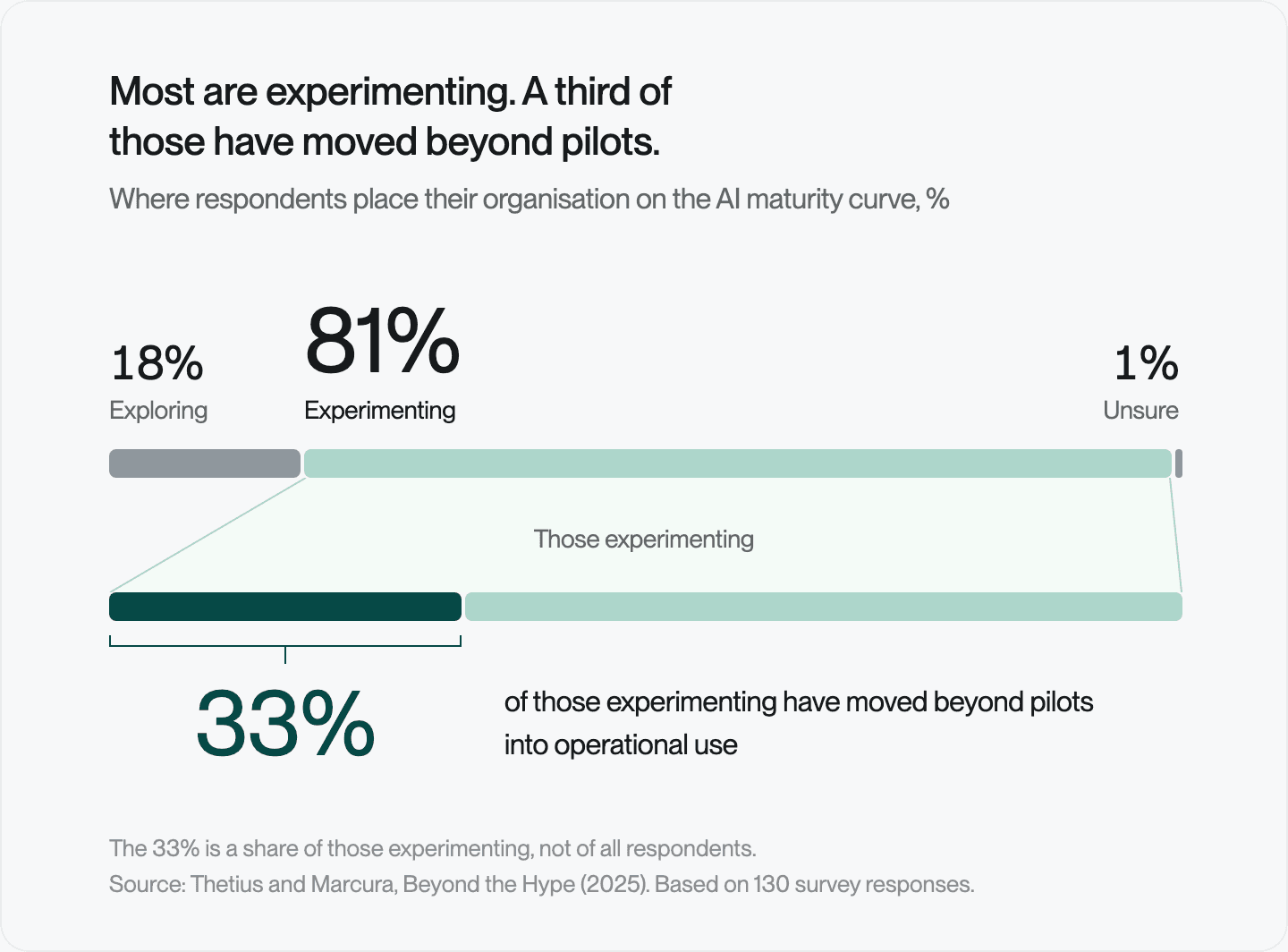
Exhibit 1: most are experimenting, and a third of those have moved beyond pilots. The 33% is a share of those experimenting, not of all respondents. Source: Beyond the Hype (2025), 130 survey responses.
Those pilots mostly sit within low-risk workflows or non-core functions. That points to a healthy appetite to explore AI, the report argues, held back by a hesitance to move too fast without proven results.
What are the four stages of AI maturity in maritime?
Beyond the Hype describes four stages of AI maturity: awareness, experimentation, adoption and maturity. When respondents placed their organisations on this curve, the answers clustered around the early-to-mid stages.
Awareness: the organisation sees AI’s potential and may have started the conversation, but has no concrete projects yet.
Experimentation: small-scale tests, such as a weather routing tool on two ships, to learn and build internal confidence.
Adoption: a successful pilot rolls out across a fleet and into core workflows. Only a smaller subset of maritime players has reached this stage.
Maturity: AI is embedded in operations and strategy, likely backed by in-house expertise, a governance framework and value measured in business outcomes.
In the report’s own view, rather than as a survey finding, the climb is getting faster: new technologies once took 10 to 15 years to become standard, while AI is moving from pilot to meaningful adoption in 2 to 3.
How do maritime professionals feel about AI?
Most maritime professionals are optimistic about AI but hesitant to rely on it, a pattern the report calls a trust paradox. In the Beyond the Hype survey, 40% are highly optimistic and see significant potential for improvement in maritime operations, and 41% are cautiously optimistic. Yet 37% have witnessed AI projects failing or causing harm, and the report notes that respondents remain optimistic, which the report reads as an industry learning from mistakes rather than abandoning AI.
Emotional responses can still lead to resistance, especially when AI feels unfamiliar or threatening. For charter managers, operations managers and captains, an “autonomous system” making calls can feel like a threat to hard-won expertise, even when the AI only recommends. “Many operators fear losing control. They’ve spent decades honing their judgment in high-stakes roles like chartering and operations,” Janani Yagnamurthy, VP Analytics at Marcura, explains in the report.
Language can widen the gap. Calling tools “intelligent” or “autonomous” invites people to trust them more than they should. “Misleading language risks over-trust,” one ship manager told the researchers. A frame from BetterUp and Stanford research, which the report borrows, helps here: people with a “pilot” mindset see AI as a way to augment what they do, while “passengers” feel carried along by it and sense a loss of control. Maritime, it argues, needs willing co-pilots, not reluctant passengers.
Which teams are most ready for AI?
In the Beyond the Hype survey, IT and digital transformation teams are seen as the most prepared for AI, with compliance and legal well behind.
Departments respondents see as prepared for AI implementation
Department | Seen as prepared | Attitude |
|---|---|---|
IT and digital | 31% | Optimistic, wary of reliability |
Operations and voyage | 25% | Routine autonomy, with oversight |
Compliance and legal | 13% | Strict human in the loop |
Beyond these three teams, commercial managers worry about losing the human touch in client relationships, where deals often hinge on personal trust. Frontline workers, the report finds, are at the greatest risk of being left behind, possibly because of insufficient training or uncertainty about how AI will affect their roles.
Where do maritime professionals see AI delivering value?
The Beyond the Hype survey shows maritime professionals embracing AI first where it supports human judgement rather than replacing it: 97% rate AI useful or extremely useful for reducing manual workflow inefficiencies, and 85% say the same for identifying risky voyage decisions and for regulatory compliance monitoring (Exhibit 2).
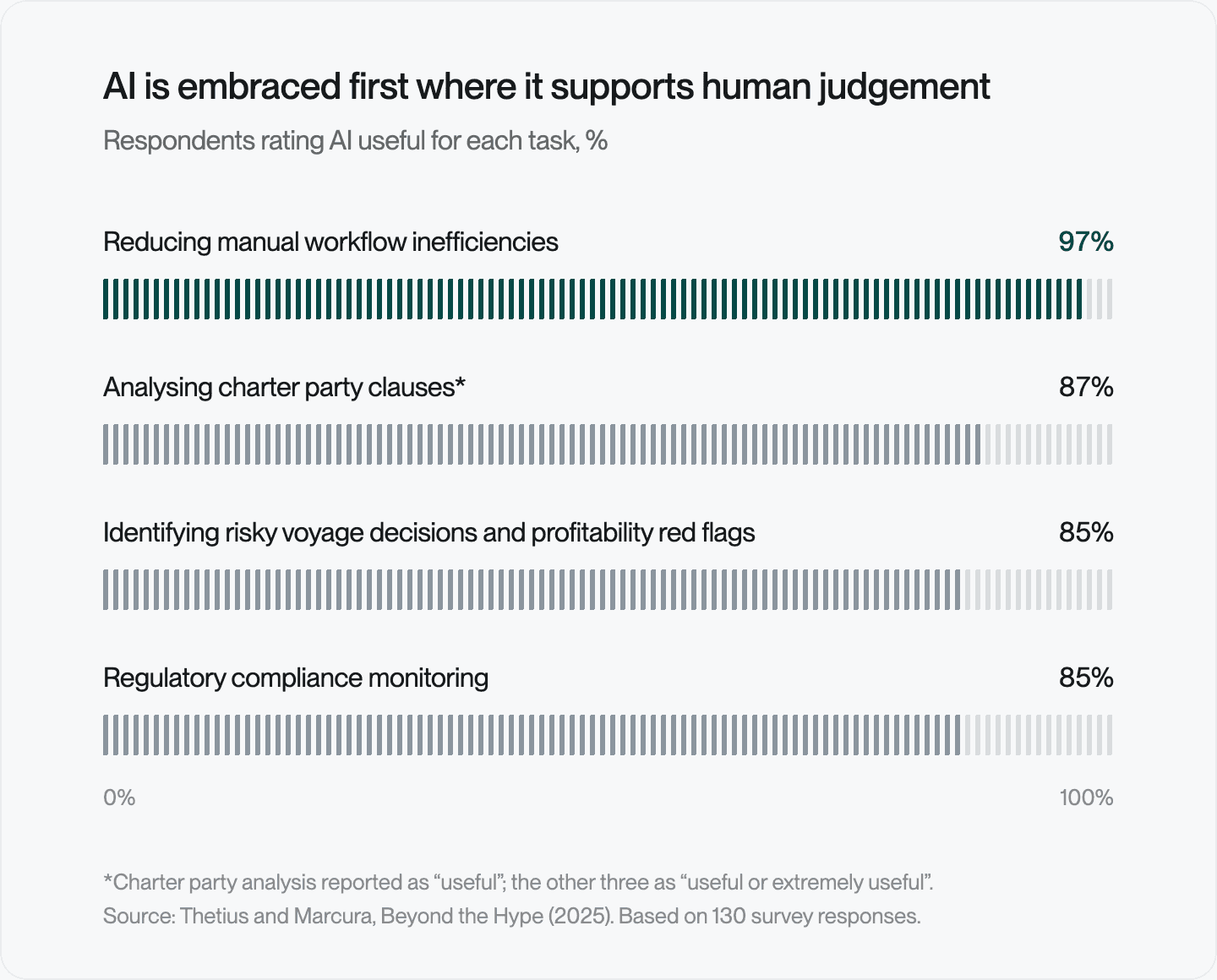
Exhibit 2: AI is embraced first where it supports human judgement. Charter party analysis was reported as "useful"; the other three as "useful or extremely useful". Source: Beyond the Hype (2025), 130 survey responses.
Manual workflows are a popular starting point because the risk is low. The report’s example is AI that augments inboxes to flag key data automatically: it “does not make decisions, but instead organises information and enhances visibility.” Compliance monitoring scores as highly as voyage risk, a theme Marcura explores in its report The fragmentation problem in maritime compliance.
Can AI analyse charter party contracts?
Charter party analysis is one of the uses maritime professionals rate highly. In the Beyond the Hype survey, 87% see AI as useful for analysing clauses in charter party contracts, where it is being used to scan lengthy documents to identify risks or extract key information.
The same respondents are wary of what AI might miss. 69% worry about poor business outcomes if AI solutions miss critical red flags in contracts or voyage planning. The report’s reading is that contract analysis must be done with caution and human oversight. AI supports the decision, but whether to accept a clause still lies with people.
Should AI make decisions in shipping?
Most maritime professionals say AI should not make decisions on its own. In the Beyond the Hype survey, 70% believe AI should recommend actions, but humans should always make the final decision (Exhibit 3). 15% would let AI make autonomous decisions in routine operations, and 13% think it should only provide data analysis, not recommendations.
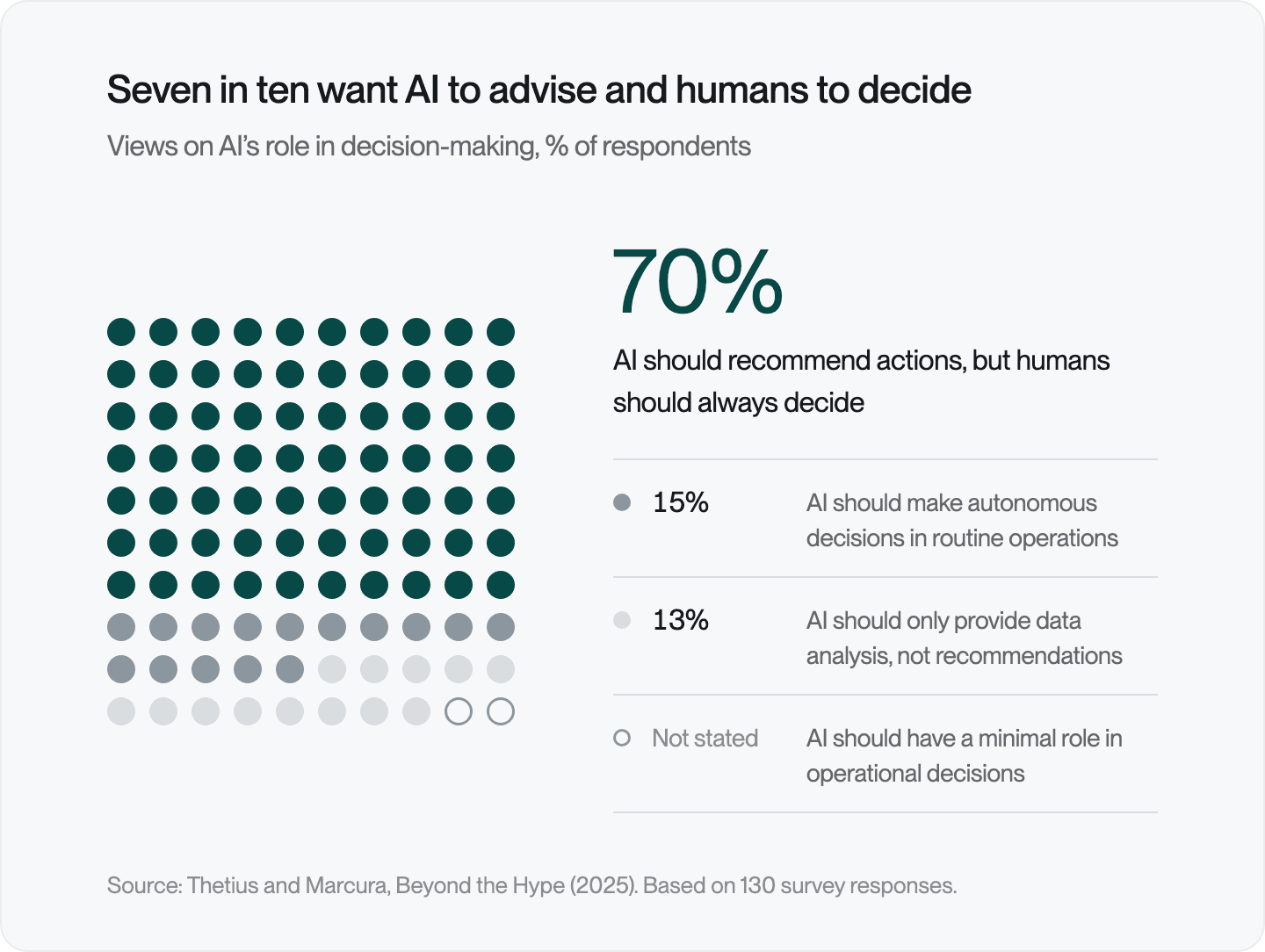
Exhibit 3: seven in ten want AI to advise and humans to decide. The report shows a fourth option, "AI should have a minimal role in operational decisions", without a value. Source: Beyond the Hype (2025), 130 survey responses.
The report’s own position is clear: “A human should always be kept in the loop in AI decision making.” Where trust is low, it recommends starting with decision-support tools that let experts audit, override or question AI outputs.
“If you use AI correctly as an assistant tool, and not as a replacement for a human, it will be a great addition to the work of every single person.”
Giuseppe Oliveri
,
Director, d'Amico
Can AI understand the nuances of maritime work?
Most maritime professionals are only partly confident that AI can handle the nuances of maritime work. In the Beyond the Hype survey, 69% are somewhat confident that AI systems can understand and handle the specific nuances of maritime contracts, workflows or operational requirements, but feel more work is needed. Only 14% are very confident, and 15% are not confident (Exhibit 4).
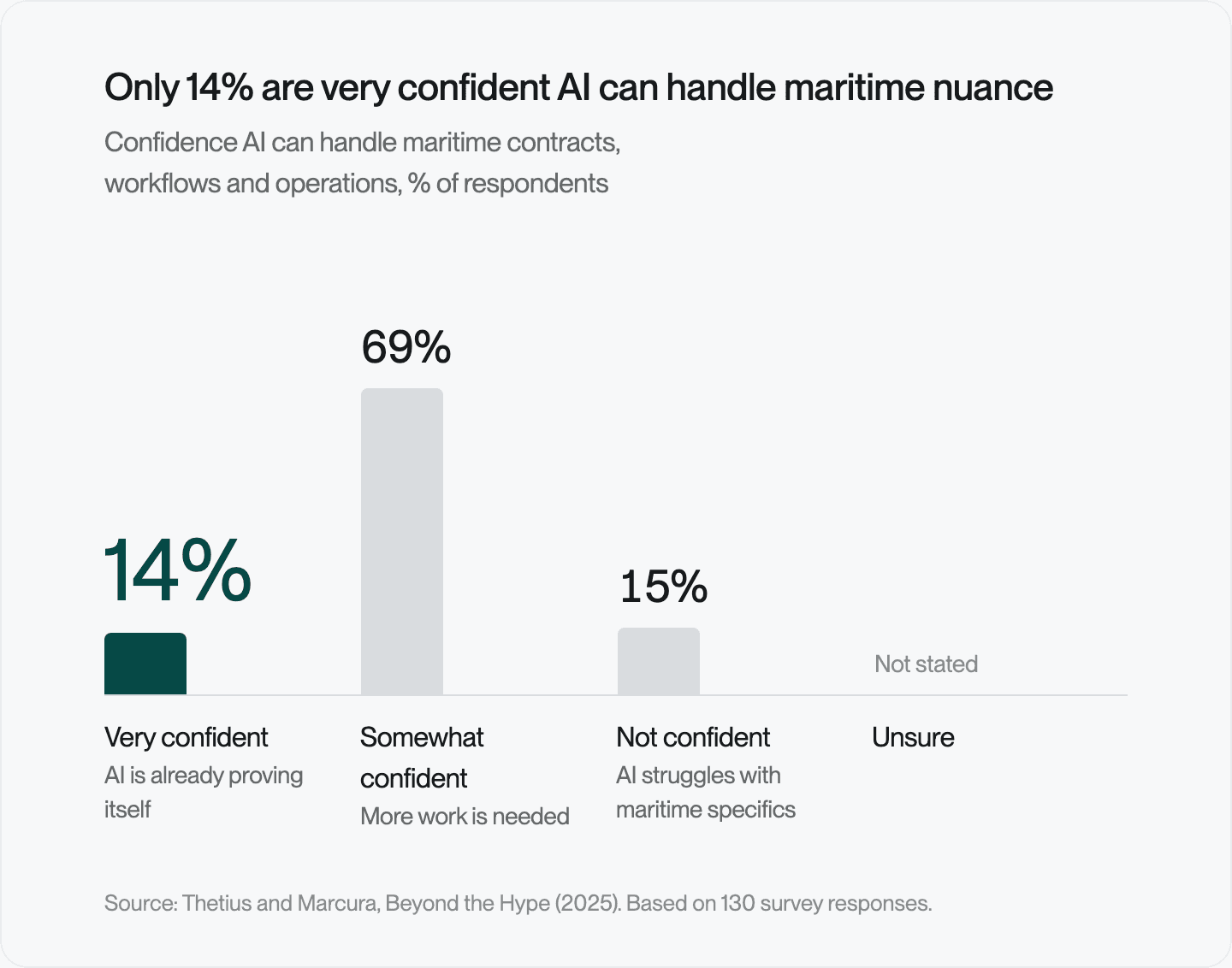
Exhibit 4: only 14% are very confident AI can handle maritime nuance. The report shows an "unsure" share without a value. Source: Beyond the Hype (2025), 130 survey responses.
The gap shows up as hallucination. Generic AI that doesn’t understand maritime operations or contracts can present errors as fact. One respondent described AI “misinterpreting technical subsystems and functions of some devices, causing absolutely wrong proposals/answers”.
“A general AI agent might say that SF means standard form, but in shipping, it means storage factor. That level of contextual accuracy is critical but doesn't come out of the box.”
Janani Yagnamurthy
,
VP Analytics, Marcura
What is vertical AI?
Vertical AI is AI built for a specific industry, using deep sector knowledge and specialised data to deliver high-precision outcomes, as distinct from general-purpose tools such as ChatGPT. In maritime, that means models trained on accurate, labelled data from maritime use cases. In one example the report cites, thousands of satellite images were labelled to train a ship-to-ship transfer detection model.
Beyond the Hype argues that vertical AI is the answer to the nuance problem, and that it builds trust faster because it delivers value sooner. Data quality matters as well. As one head of marketing at a technology company put it, “AI with poor quality data is just smarter and faster stupidity.”
What are the biggest risks of AI in maritime?
Three risks carry the highest figures in the Beyond the Hype survey: AI missing critical red flags, the loss of human skills, and cybersecurity and data breaches. They sit alongside wider concerns, from hallucinations to vendor hype.
69%
fear poor outcomes if AI misses red flags
66%
worry overreliance could erode human skills
61%
see cybersecurity and data breaches as top risks
Source: Thetius and Marcura, Beyond the Hype (2025). Based on 130 survey responses.
Six risks, and the opportunity in each
Beyond the Hype pairs six of the risks it examines with the opportunity each one opens.
Risk | The fear | The opportunity |
|---|---|---|
Job losses | AI replaces people and teams shrink | New roles and more time for skilled work |
Hallucinations | Generic AI presents errors as fact | Maritime-trained models misread less |
Vendor hype | Solutions fall short of the promise | Realistic promises, maritime-specific models |
Data privacy | Sensitive data is exposed or leaked | Right architecture plus human oversight |
Model collapse | AI trained on AI output plateaus | Real-world data becomes a competitive edge |
Regulation | Unclear accountability when AI fails | Responsible pilots and upskilled teams |
Vendor hype is a trust risk in its own right. 23% of respondents feel vendors are generally untrustworthy, offering too much hype and insufficient results. Some tools sold as “AI-powered” are really robotic process automation or rule-based logic, and several participants named vendor lock-in or technology dependence among their biggest risks. In the report’s words, “The real risk is not always the AI, it’s the hype, poor fit, and false expectations.”
Openness changes that. Ha Eun Ruppelt, a Maritime Transformation Advisor, saw it on an AI project at a shipping company: the vendors walked the team through their data sources, cleaning methods and calculation logic, and “that openness built the trust we needed to move forward.”
Will AI replace jobs in shipping?
Fear of AI replacing jobs in shipping is real, but held by a minority in the Beyond the Hype survey. 15% of respondents are very concerned, and a further 23% a little concerned, that AI could replace rather than assist them in their roles. Many understand that AI is designed to automate repetitive, execution-level tasks, not strategic thinking. One CEO who responded to the survey put it plainly: “I’m not looking to cut headcount with AI, I’m looking to handle 2x the business with the same headcount.”
“AI will create shore-based roles like fleet analytics or remote support. It's not a replacement; it's a shift.”
Theofano Somaripa
,
Group CIO, Newport S.A.
Why do maritime AI projects stall at the pilot stage?
The main barriers to scaling AI in shipping are human rather than technical, Beyond the Hype finds. 38% of respondents call skills and training requirements a huge blocker when scaling AI, yet only 23% say their organisation has implemented training to build trust in AI among staff. Only 17% say their organisation has taken steps to be transparent about how AI will make decisions (Exhibit 5).
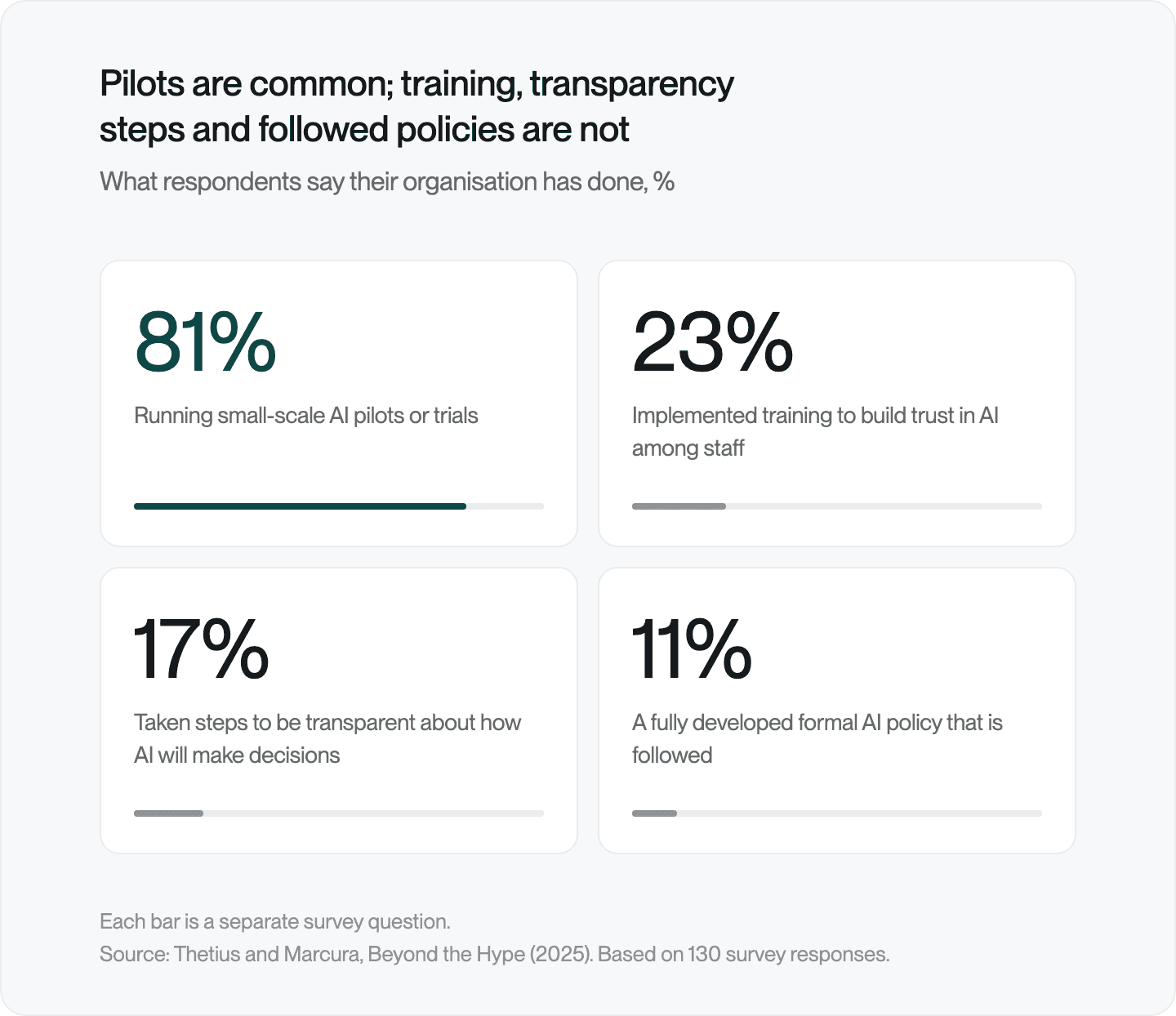
Exhibit 5: pilots are common; training, transparency steps and followed policies are not. Each bar is a separate survey question, not a funnel. Source: Beyond the Hype (2025), 130 survey responses.
The report names five blockers to scaling:
Skills and training gaps: a competence gap that inhibits practical, confident use of AI.
Fear of disruption: interviews found it outweighs the fear of stagnation, and buyers who cannot see a clear ROI hesitate to invest.
Fear of overreliance: “We need to ensure the skill level of users remains high to spot and correct hallucinations,” said an IT project manager at a shipping company.
Fear of missing out: some adopt AI too quickly without clear use cases, then hesitate to scale when it disappoints.
Employee pushback: people at a higher level who use AI day to day are much more likely to engage with it, while those who don’t see the benefits are more likely to resist.
“People train their AI models but they don't train their people. If the crew and the office do not understand the AI outputs, it could lead to misuse, which creates mistrust. We need to first train our people and our minds.”
A ship manager
Marcura looks at why the people side decides whether AI scales in the people problem in maritime AI projects.
Do shipping companies have an AI policy?
Few maritime organisations have an AI policy that is actually followed. In the Beyond the Hype survey, only 11% of respondents say their organisation has a fully developed formal AI policy that is followed and adhered to, while 82% have guidance that is not always adhered to, or no policy at all. The report suggests this means users may be putting potentially sensitive information into open AI platforms without knowing how that data may be stored, processed or reused. “Without formal policies, even well-intentioned AI use can introduce risk.”
What makes a maritime organisation ready to scale AI?
Leadership support, employee skills and good data governance all shape how ready a maritime organisation is to scale AI, according to Beyond the Hype. 57% of respondents cite strong leadership support as having a major influence on their organisation’s readiness for AI. Employee openness and digital skills also influence readiness, say 41%, and 32% say good data governance and ownership strongly influences it.
Blame-heavy cultures tend to struggle, because employees may fear being held responsible if the AI makes a mistake. Data needs the same attention. “Put first things first: create a fleet-wide data-governance framework that makes high-quality, standardised, cyber-secure operational data continuously available for AI training and deployment,” one technology company CEO advised. The starting point is better than it looks: maritime is more AI-ready than it realises, the report argues, thanks to existing infrastructure and relationships.
What does the Beyond the Hype report recommend?
Beyond the Hype closes with seven recommendations for the maritime industry. The list below also folds in the report’s practical steps for moving people from fear to adoption.
Invest in AI tools built specifically for maritime: generic AI often misses the contractual, operational and contextual subtleties of maritime work. Tools trained on sector data and workflows are far more likely to deliver value.
Foster agency and discernment: train people to understand, assess and use AI, and show them it is a co-pilot, not a new member of staff. 46% of respondents see training and education around AI’s role as key to building trust.
Keep the human in the loop to harness trust: AI should help people with deep knowledge and experience make decisions more efficiently, rather than make decisions on its own.
Engage with emotions, not just systems: find where resistance is highest and tailor engagement and training to it. People should feel safe to say “I don’t understand this AI”, and leaders should be upfront, because “clarity matters more than control.”
Implement governance frameworks: cover compliance, transparency, auditability and internal accountability, and pair policies with approved tools, such as a secure, vetted internal AI assistant.
Demand transparency and real-world impact from vendors: insist on detailed explanations of capabilities, training data and operational limitations, and focus on solutions proven to address actual operational challenges.
Encourage experimentation: give people time to try AI without fear that mistakes will be held against them, and treat tools that underdeliver as a chance to refine. Peer proof helps: 40% say proven use cases and success stories would make them more confident to scale.
The pilots are already running. What holds them back from scale is less the technology than the policy, the training and the trust around it. That is why Beyond the Hype treats AI adoption in maritime as a challenge of governance, culture and communication.

How was the Beyond the Hype survey conducted?
Beyond the Hype is based on 130 survey responses and multiple in-depth interviews across the maritime industry. The report, by Fiona Macdonald, was prepared by Thetius in partnership with Marcura, and Marcura first shared its headline findings in Maritime companies struggle to scale AI despite high enthusiasm. This summary was prepared by Marcura. Every percentage of respondents on this page comes from the 2025 survey; the adoption-timeline figures, quotes and examples come from the report’s analysis and interviews.
Sector: 36% technology companies, 28% shipping companies on shore, 15% maritime consultancies, 8% shipping companies at sea and 10% other, with classification societies also represented.
Seniority: 34% C-suite or executive leadership, 29% senior management, 19% specialists or professionals, 13% middle management and 5% frontline or operational staff.
Headquarters: 69% Europe, 14% Asia and 8% North America, with the rest in Australia, the Middle East and South America.
Reading the numbers: on these figures, the sample leans towards technology companies, senior leaders and European organisations. Percentages are shares of respondents unless stated; the 33% operational-use figure is a share of those experimenting. The report does not publish fieldwork dates or a full tabulation of every question, and it gives department-level views as qualitative findings rather than breakdowns by role, region or company size. Some contributors are quoted anonymously.
A later, separate study: this page covers the 2025 survey only; Thetius and Marcura’s 2026 research is covered in the 2026 Thetius and Marcura study on AI in maritime.
FAQs
Related resources