In this report
Where AI already sits in daily work: How far adoption has gone, and the gap between using AI and being ready to rely on it.
The verification tax: The time spent checking AI before anyone acts on it, and how to tell warranted checking from the kind that falls as confidence grows.
From assistant to agent: What changes as AI moves from suggesting to doing, and why governance has not kept pace.
From trust to accountability: Where a person stays on the decision, and the five priorities for putting AI to work with confidence.
63% of maritime professionals surveyed use AI every day, yet only 15% say governance is ready for AI that takes actions, according to Earning Trust: AI in Maritime, a 2026 maritime AI survey of 60 professionals by Thetius in partnership with Marcura. The trust gap is the distance between how widely maritime professionals use AI and how far they trust, check and govern it.
55%
spend an hour or more weekly checking AI
85%
say AI still saves them time overall
80%
agree a named person should be accountable
Source: Thetius and Marcura, Earning Trust: AI in Maritime (2026). Based on 60 survey responses.
Key findings from the 2026 maritime AI survey
The survey of 60 maritime professionals by Thetius and Marcura points to eight findings:
AI is part of daily work: 63% of respondents use AI every day.
Checking takes real time: 55% spend at least an hour a week checking or correcting AI outputs.
AI still saves time after checking: 85% say AI saves them more time overall once checking is counted.
Some AI errors have had real consequences: 15% say an AI error has led to a real financial, client, reputational or operational impact.
Most sit in the middle on trust: 57% rate their trust in AI outputs at the midpoint of a five-point scale.
People want a named owner: 80% partly or strongly agree a named person should always be accountable for every commercial decision.
AI agents are on the agenda: 72% say their organisation is using, piloting or planning to use AI agents.
Governance trails use: only 28% say their organisation’s governance has kept pace with AI use.
How widely is AI used in maritime?
AI is now part of everyday work for most maritime professionals surveyed: 63% use it every day, rising to 80% when weekly users are included. Most feel they are managing the pace of change. 45% say they are mostly keeping up and 22% comfortably so, while 27% say it takes real effort.
Use is not the same as maturity, though. Only 8% describe their organisation as mature and governed in its use of AI. “Adoption is not really a thing. It’s old news,” said Agnieszka Urszula Nowinska, Associate Professor at Aalborg University Business School. The question now, she said, is “how fast and how well can we pull that off?”
Where does AI already sit in daily maritime work?
In maritime, AI is already used to draft contractual wording, review documents, organise correspondence and support analysis. Charter party review is one example: a small change in wording can have significant effects on a high-value agreement. AI can flag potentially costly clauses, leaving the chartering manager to make the commercial judgement. Thomas Stjernholm, Managing Director - Commercial at Tomini Chartering, described the AI-supported charter party system his company is implementing as a “collective brain” for the organisation.
Other uses are still emerging. 10% of respondents selected voyage instructions and planning as areas where AI is used in their work today, and 3% selected claims preparation. See also: how AI risk analysis changes charter party negotiations and maritime AI use cases.
Where do maritime companies get their AI tools?
General-purpose providers are the largest single source of AI capability for maritime companies in the survey, though not a majority. 42% of respondents said their organisation gets its AI capability mainly from general providers such as ChatGPT or Copilot, against 10% from specialist maritime vendors. The rest build in-house (23%), use vendor tools adapted in-house (13%) or are not sure (12%) (Exhibit 1).

Exhibit 1: general AI providers are the largest single source of AI capability, though not a majority. Source: Earning Trust: AI in Maritime (2026), 60 survey responses.
Does AI save time once you count the checking?
Yes, for most respondents. 55% of maritime professionals surveyed spend at least an hour a week checking or correcting AI outputs. Yet 85% still say AI saves them more time overall once checking is counted in. 73% say AI is enabling them to do things they could not do without it. Checking can erase the gain, but for most it does not.
“If I can complete a task manually in ten minutes, but AI generates an answer in one minute that then requires fifteen minutes of checking, correction and source verification, there has been no productivity gain.”
Abbas Alipanah Kordlar
,
Senior AI Development Specialist at Digital Exchange
What matters, the report argues, is whether the complete human-AI workflow is better than the process it replaced. 60% of respondents would accept an occasional AI error on everyday tasks in exchange for the time it saves. The report expects that tolerance to narrow sharply as the stakes rise.
What is the verification tax?
The verification tax is the time and effort required to check AI-generated work before it can be used or acted upon with confidence. Thetius and Marcura’s 2026 report introduces the term. It covers more than review time: moving between the AI output and the original materials, locating evidence and correcting errors all count. It becomes a problem when that effort outweighs what the AI-assisted workflow delivers. For which checks to keep and how to bring the rest down, see how to measure and reduce the verification tax in shipping.
What is the difference between warranted and residual verification?
Warranted verification is checking that the consequences of an error justify. It matters when an AI recommendation could change a company’s contractual position, or when port restrictions could affect whether a fixture is viable. In sanctions, reliable evidence and audit trails may still be needed even when the AI has performed well before.
Residual verification comes from uncertainty and lack of trust. A user keeps checking because they do not fully trust the system, do not understand how it reached the answer or do not know who owns the outcome. The report argues companies should keep the first kind and reduce the second, though some residual checking is perfectly rational while systems are still being established.
How can companies measure the verification tax?
Measuring the verification tax means examining the entire process against a baseline, and that baseline is hard to come by. “We don’t have benchmarking data,” said Rajesh Gopinathan, Head of Business Transformation at Seaspan. The report suggests counting escalation delays and the cost of locating evidence, not just review time, along with how often outputs are amended or overridden. It adds that if reviewers approve outputs without properly validating them, a low verification time is not evidence of a tool’s maturity.
How often does AI get things wrong in maritime work?
Errors turn up regularly when maritime professionals check AI output. 47% of respondents find errors sometimes when checking AI outputs, 18% often and 8% almost always. The rest find them rarely (22%) or almost never (3%), and 2% don’t know or don’t check. Separately, 15% say an AI error has already led to a real financial, client, reputational or operational impact. Another 12% say one was caught before it had an impact (Exhibit 2).
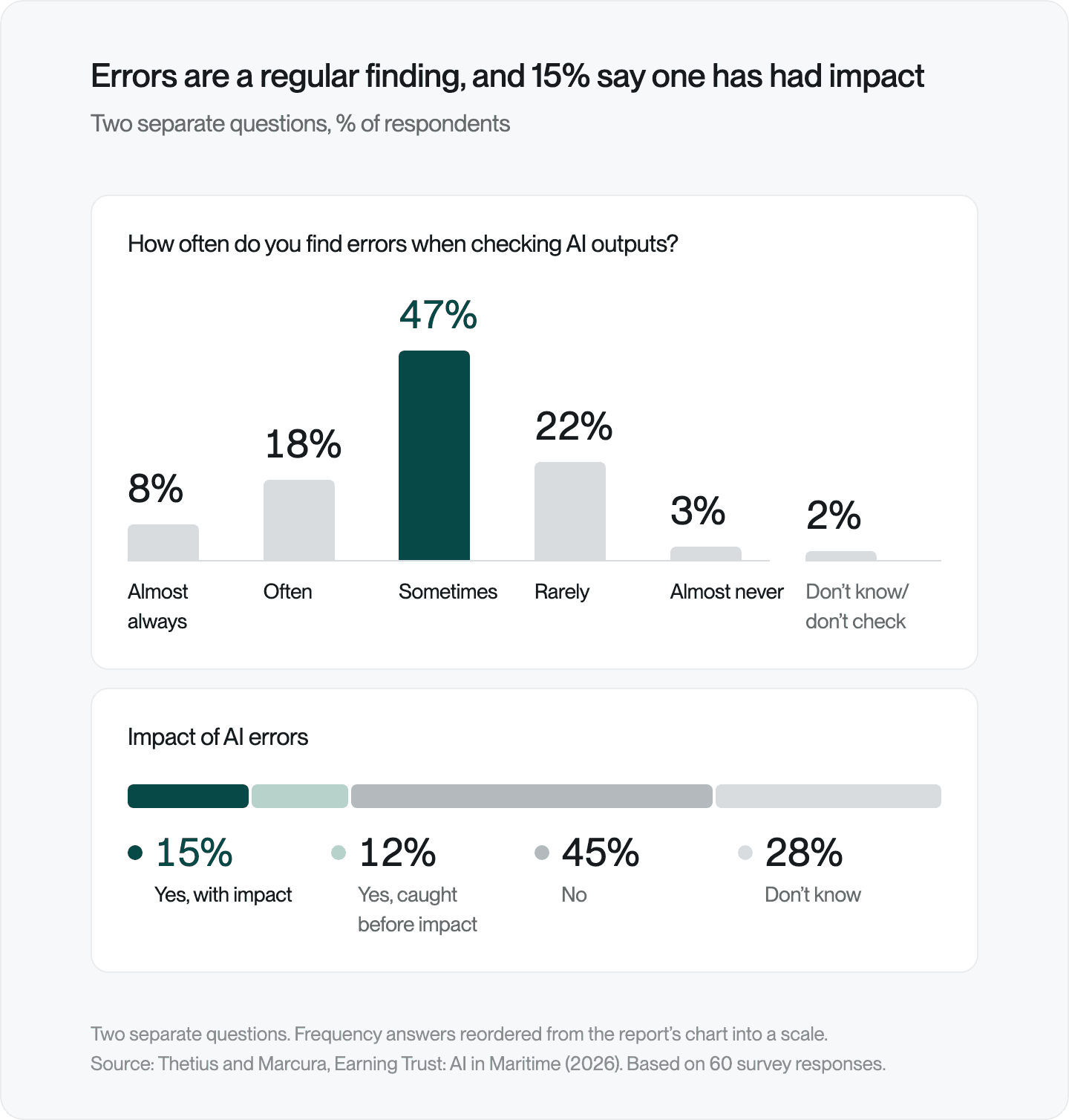
Exhibit 2: "sometimes" is the most common answer on how often errors turn up. Two separate questions; frequency answers reordered into a scale. Source: Earning Trust: AI in Maritime (2026), 60 survey responses.
On the impact question, 45% answered no and 28% didn’t know. Errors don’t always look like errors. “If it sounds good, people trust it. The issue is that an AI assumption can be hidden inside language that appears professionally written,” said Thomas Örnevik, Chief Executive Officer at MARANICS.
Do maritime professionals trust AI outputs?
Most maritime professionals surveyed sit in the middle on trust. 57% rated their trust in AI outputs at the midpoint of a five-point scale, with relatively few at either the highly trusting or highly sceptical ends. 70% say they would always check an AI recommendation before acting on an important business decision.
Proven reliability would change that for many, but not all. If an output had proved reliable over time, 47% would do much less checking or stop entirely. 38% would still do most or all of it. As Kordlar of Digital Exchange put it, “the objective is not maximum trust. It is calibrated trust. A system should be trusted to perform work it has proven it can do, not assumed to be reliable in every situation.”
“The decision-making stays with the buyer. We’ve kept humans in the loop from the start because confidence in AI recommendations has to be earned before you hand over more of the decision.”
Saurish Nandi
,
Head of AI-Driven Procurement Innovation & Sustainability at Marcura
Who is accountable when AI shapes a commercial decision?
A named person, according to most maritime professionals surveyed. 80% partly or strongly agreed that, however capable AI becomes, a named person should always be accountable for every commercial decision. The interviews found no single industry view, though, on where that responsibility should sit between the company and the individual.
Where responsibility for AI-assisted decisions should sit: three views from the interviews
Interviewee | Responsibility sits | Why |
|---|---|---|
Thomas Örnevik, MARANICS | More with the company | It chooses and controls the technology |
Thomas Stjernholm, Tomini Chartering | More with the individual | A contract owner cannot pass it to AI |
Agnieszka Urszula Nowinska, Aalborg University | Shared by user and organisation | Exact balance still undecided |
For Kordlar, the answer has to be settled early: “I do not think ‘the AI made the decision’ can ever be an acceptable endpoint for accountability. Responsibility may be distributed, but it needs to be defined before deployment rather than negotiated after something has gone wrong.”
The report puts the objective and its owner first, before a tool is selected. It calls for an audit trail showing which system was used, what information it accessed and whether a person changed or rejected its recommendation. Leadership needs a realistic picture too, yet only 40% of respondents described their senior leadership’s understanding of AI as realistic.
How much human oversight does maritime AI need?
Human oversight of maritime AI should track the consequences of an error, not the technology behind it, the report argues. Sensitive information or less familiar tasks usually need tighter controls. Lower-risk work can be handled more lightly where mistakes are easy to spot and correct, moving towards sampling once a system has proved reliable. Higher-consequence decisions should require formal human approval.
How human oversight can match the stakes of the task
Task | Where AI may help | What stays with a person |
|---|---|---|
Contracts and sanctions | Organising the evidence | Contract exposure and sanctions calls |
Claims | Document review, with limited oversight | Final decision and settlement figure |
Commercial negotiations | Background and precedent | Real-time judgement calls |
Procurement | Initial supplier comparison | May need approval above a value threshold |
Customer communications | Drafting a response | May need sign-off before it reaches the client |
The stakes change once an error leaves the organisation. “We’re most cautious about errors being transmitted externally. Internal errors can be caught and managed, but external errors can damage reputations,” said Jack Kitching, Master and Operations Manager at Islands Unlimited. The report adds that escalation should be triggered by the potential business consequence of an output, not by a tool’s confidence alone. See also: why maritime claims still needs a human in the loop.
“It’s a human-to-AI-to-human process: the human puts in the knowledge, the AI curates and connects it to the clause in front of you, and the human makes the final decision.”
Thomas Stjernholm
,
Managing Director - Commercial at Tomini Chartering
Is maritime ready for agentic AI?
Interest in agentic AI is running ahead of readiness among maritime professionals surveyed. 72% said their organisation is using, piloting or planning to use AI agents. Yet only 15% said governance is ready for AI to take actions rather than simply making recommendations. Asked whether governance is ready for agentic AI, 30% said partly, 23% no and 18% didn’t know, while 13% said they have no governance at all (Exhibit 3).
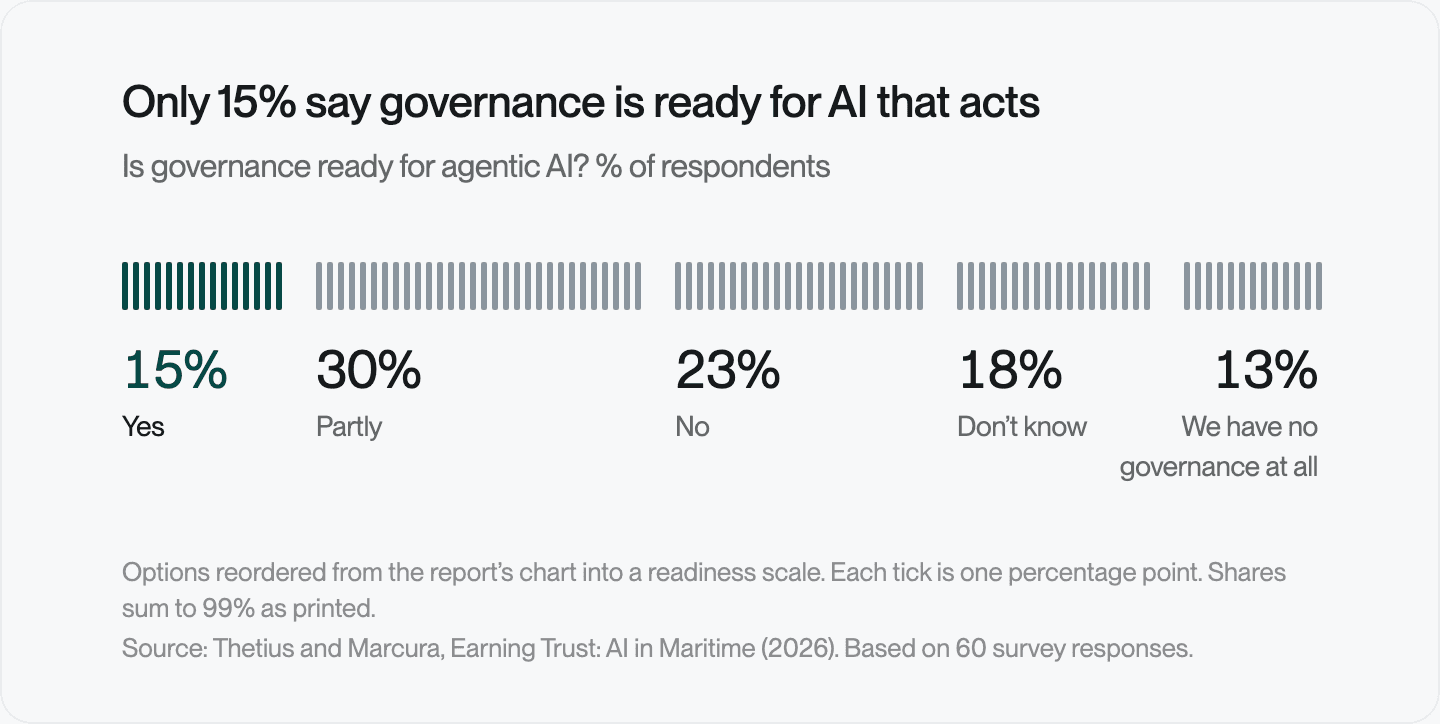
Exhibit 3: "partly" is the most common answer on agentic readiness. Shares sum to 99% as printed. Source: Earning Trust: AI in Maritime (2026), 60 survey responses.
Agentic systems can access information, retain context and use connected tools to perform tasks, which can also increase the consequences of an error. Kordlar said that “giving a human an override button is not necessarily meaningful human control if, when something goes wrong, that person does not have enough information, time or readiness to intervene effectively.”
The report cites UK National Cyber Security Centre advice to start with low-risk tasks and introduce agents gradually through clearly defined use cases. Trust should grow task by task. A system that reliably extracts information from documents has not automatically proved it can make commercial recommendations. See also: why agentic AI is maritime’s next leap.
What makes AI output trustworthy?
AI output is only as trustworthy as the data, testing and feedback loops behind it, the report argues. The starting point is a reliable information base for the task, not cleaning every dataset first. As Örnevik of MARANICS put it, “better data doesn’t mean more data.” The report recommends testing systems against historical cases and feeding users’ corrections back into evaluation. Performance should be judged task by task: a system can be very good at extracting dates but much less reliable at interpreting contractual obligations.
Will AI weaken skills, and how much AI training do staff get?
Maritime professionals see AI as both a shortcut to experience and a risk to it. 75% of respondents said AI is helping less experienced colleagues become effective faster, by giving them access to knowledge that would otherwise take years to build. Yet 88% expressed at least some concern that relying too much on AI could weaken human skills and judgement over time. Training is uneven: only 30% said their organisation had provided some or comprehensive training on using AI safely.
75%
say AI speeds up less experienced colleagues
88%
have concerns AI could weaken skills
30%
have had training on using AI safely
Source: Thetius and Marcura, Earning Trust: AI in Maritime (2026). Based on 60 survey responses.
“Don’t replace muscle memory with AI,” said Janani Yagnamurthy, Senior Vice President, Product, Strategic Growth at Marcura.
Has AI governance kept pace with adoption?
AI governance in maritime is lagging behind adoption, the survey suggests. Only 28% of respondents said their organisation’s governance had kept pace with the use of AI internally. Of the other answers, 25% said AI use had outpaced governance and 23% said their organisation had no governance in place at all. 20% were unsure and 3% did not respond (Exhibit 4).
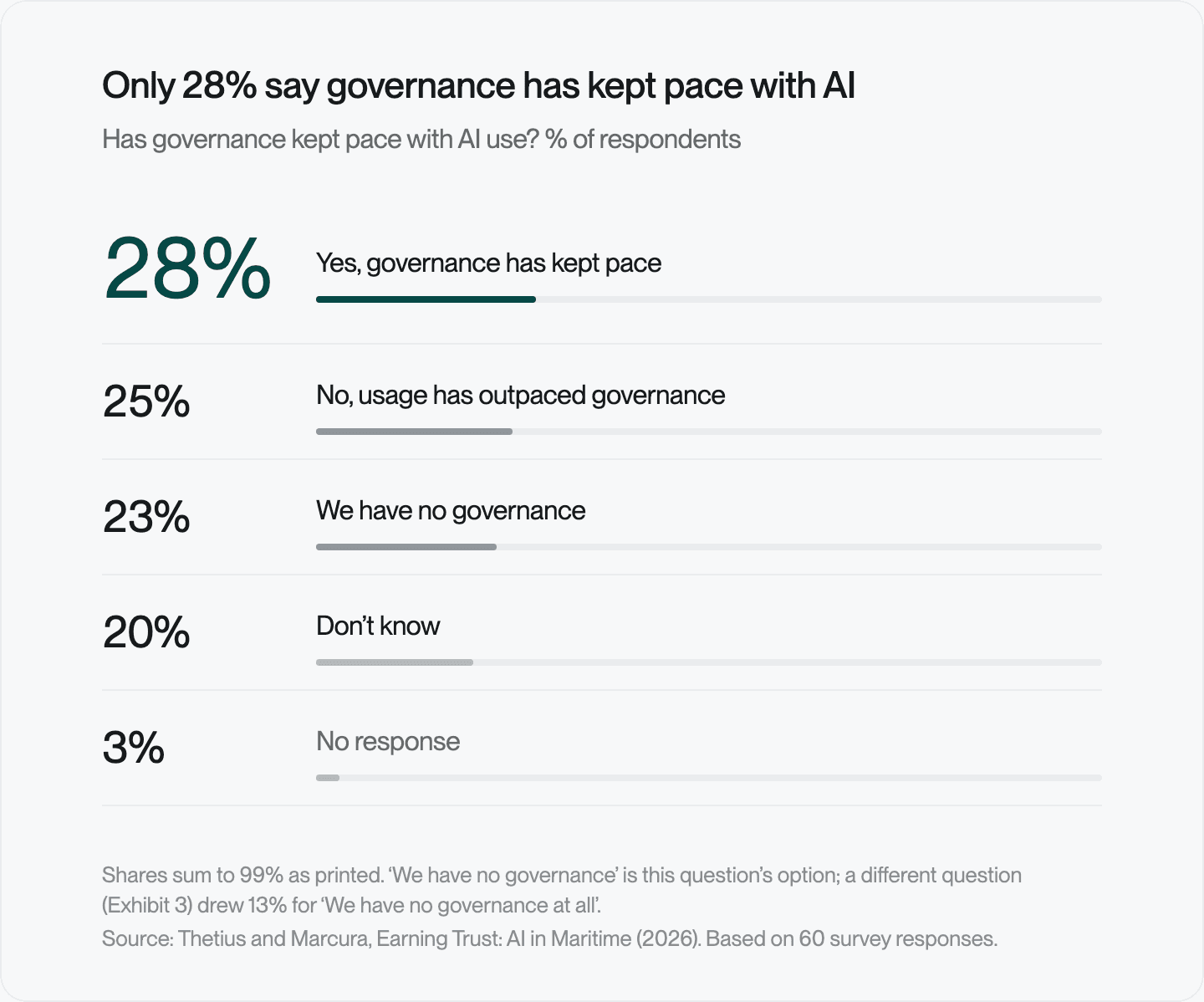
Exhibit 4: answers split four ways on whether governance has kept pace with AI use. Shares sum to 99% as printed, including a 3% "no response". Source: Earning Trust: AI in Maritime (2026), 60 survey responses.
Where governance exists, it often covers tools rather than decisions. Only 8% said their organisation’s AI governance includes human sign-off on AI-influenced decisions. Larger shares said it covers an approved-tools list or an acceptable-use policy. One senior IT and cybersecurity leader at a shipping company argued that AI cannot be treated like other software: “It’s not a PDF and Acrobat PDF reader. It’s an AI tool that has access to your data.”
The report recommends keeping a record of the AI systems in use and who owns each one. It also suggests asking vendors how customer data is stored, whether it trains the model and what happens when the system is updated. AI governance should fit within existing risk and compliance structures. Regulation is moving too. The EU AI Act became broadly applicable on 2 August 2026, although some provisions follow later timelines, and its AI literacy requirements have applied since February 2025.
What is shadow AI, and how common is it in shipping?
Shadow AI is the use of AI tools or accounts for work without the organisation’s approval or oversight. In maritime, that could mean using a public model to help draft contractual wording or review correspondence. 48% of respondents said people in their organisation use unofficial AI tools for work at least occasionally.
Before one shipping company launched its corporate AI tool, an internal exercise “identified that more than 50% of the group was utilising 22 different generative AI applications,” according to a senior IT and cybersecurity leader there. Nowinska of Aalborg University argued the more useful question is “why are people doing that in the first place?”
“You cannot stop people from using AI. It is there. People are seeing the benefit of it.”
Rajesh Gopinathan
,
Head of Business Transformation at Seaspan
Banning unofficial AI use rarely works, the report argues. A better sanctioned alternative does, provided it works well enough that employees actually use it. See also: why maritime AI fails on people, not technology.
What should maritime companies do about AI trust and governance?
Earning Trust: AI in Maritime sets out five priorities for maritime companies:
Start with the workflow: begin with a specific workflow or problem rather than looking for somewhere to deploy AI, and map how the work is done today. That map becomes the baseline for judging the new workflow.
Measure the complete human-AI workflow: compare the AI-assisted workflow directly with the process it replaces, on time, quality, capability and the value created.
Match verification to the consequences of getting it wrong: reduce the checking that comes from uncertainty, not the checking a decision genuinely warrants. Trust should be calibrated, earned task by task rather than assumed for a system as a whole.
Turn verification into a learning process: capture what reviewers find rather than losing it once a task is finished, because repeated corrections can point to a problem in the underlying data or the workflow.
Establish ownership and governance: be clear who owns each AI-enabled workflow and where issues escalate, whether the system was built in-house or bought in. Put governance questions directly to vendors, and give employees an approved option good enough to actually use.
Maritime has stopped asking whether AI is useful, the report’s executive summary says. “The open question now is how to capture its productivity gains while building the trust, accountability and governance needed to use it with confidence.”
For maritime companies, closing the trust gap means settling, task by task, how much checking the work warrants, who owns the outcome and whether governance keeps up with daily use.

How was the survey conducted?
Earning Trust: AI in Maritime is based on a survey of 60 maritime professionals and in-depth interviews with maritime operators, technology specialists and researchers. Thetius conducted the research in partnership with Marcura, and Matt Stevens wrote the report. Marcura first shared the headline findings in the announcement of the Earning Trust research. This summary was prepared by Marcura.
Sector: 38% technology providers, 17% owner-operators, 10% ship managers, 8% asset-light operators, 2% tramp or spot operators and 25% other.
Seniority: 27% senior management, 27% middle management, 25% C-suite, 13% specialists and 8% frontline.
Geography: not published.
Reading the numbers:
Sample skew: the sample leans towards technology providers and senior roles, and with 60 respondents, small differences should be read with care.
Not published: fieldwork dates, geography, the number of interviews, per-question bases and whether questions allowed more than one answer.
Quirks: some charts sum to 99% or 101% as printed, and the 8% mature and governed figure has no published chart. The “no governance” option drew 23% on governance pace and 13% on agentic readiness.
Marcura voices: two of those quoted, Saurish Nandi and Janani Yagnamurthy, work at Marcura.
The 2025 study: the 2026 report is the follow-up to Beyond the Hype, the 2025 Thetius and Marcura report. This year’s respondents are different. The report therefore treats its 2025 comparisons as an indication of how views are changing, not a like-for-like trend, and this summary does not repeat them.
How to cite: Thetius in partnership with Marcura, Earning Trust: AI in Maritime (2026), by Matt Stevens. Survey of 60 maritime professionals.
FAQs
Related resources