
This article is part of a series exploring the findings of Marcura’s 2026 report, The Fragmentation Problem in Maritime Compliance. In the weeks ahead we will share insights from leading industry practitioners including Enesel, Emirates Shipping Line, Pacific Basin and the Maritime Anti-Corruption Network, examining how maritime organisations are navigating a rapidly evolving compliance landscape.
An everyday story
A compliance officer starts Friday morning with hundreds of regulatory alerts in her inbox. Three jurisdictions have updated their sanctions lists overnight. A charterer needs sign-off on a vessel by noon. Procurement wants to know why a long-standing supplier is suddenly flagged. Finance is querying a bank account change.
By Thursday evening one question lingers:
Did we miss something?
For many maritime organisations, this scenario has become routine. Compliance demands are expanding rapidly as sanctions regimes diverge, enforcement expectations rise and regulators increasingly expect organisations to identify risks before breaches occur.
This challenge sits at the centre of Marcura’s 2026 report, The Fragmentation Problem in Maritime Compliance, which explores how maritime organisations are struggling to scale compliance processes as regulatory complexity intensifies.
But the pressure facing compliance teams is not simply regulatory. It is structural.
According to our research, the estimated hidden cost of onboarding and KYC per counterparty is between US$1,500 and US$3,500. In markets where counterparties change frequently, this compounds quickly.
The financial cost is only part of the story. The greater risk lies in inconsistency. When different systems produce different answers, confidence erodes, and teams spend more time validating tools than assessing risk.
Compliance teams become the manual integration layer, piecing together a risk picture from fragmented information.

Do you know the risks you can take, and the ones you can't?
Get practical advice from the people living these decisions every day
The industry perspective
Maritime operators recognise the pressure this creates.
Bianca Knight, General Manager of Commercial Claims at Pacific Basin Shipping, describes how sanctions expansion exposed the limits of manual processes:
“When there was a sudden spike of sanctions in 2022, our manual process simply wasn’t designed to cope with the increase in volume.”
At the same time, the regulatory environment itself has grown significantly more complex.
Fieke Nijland, Vice President Legal Counsel at Emirates Shipping Line, explains:
“Sanctions compliance used to be simpler. Twenty years ago you knew which countries were off limits and avoided them. Today the regulatory landscape is far more complex.”
Compliance teams must now manage multiple regulatory regimes, increasingly opaque ownership structures and a broader universe of risk while working within infrastructure that was never designed for this level of complexity.
The deeper issue: knowledge doesn’t travel
As explored in Marcura’s compliance report, fragmentation creates more than operational inefficiency. It prevents the industry from learning collectively about risk.
Across shipping today, the same counterparty may be vetted by dozens of organisations. If one organisation discovers a fraudulent supplier, compromised bank account or high-risk ownership structure, that intelligence rarely travels beyond its own systems.
The next organisation encountering the same counterparty often repeats the same due diligence process from scratch.
This creates a system where maximum effort produces minimal collective protection.
Rethinking the Model
Shipping is not the only industry to face this challenge. Payments infrastructure, credit scoring, and even maritime safety protocols evolved through shared frameworks, where verification and standards are recognised across participants rather than recreated in isolation.
The question is whether maritime compliance can follow a similar path, treating compliance as shared infrastructure. That means:
Verification to be performed once rather than repeatedly
Risk intelligence to move across operational workflows
Standardised data structures to reduce ambiguity
Collective learning about compliance threats
Instead of fragmented checks scattered across organisations, the industry would operate on a foundation where validated information can move with the transaction.
Where organisations can start
Moving toward shared infrastructure does not require an all-or-nothing shift.
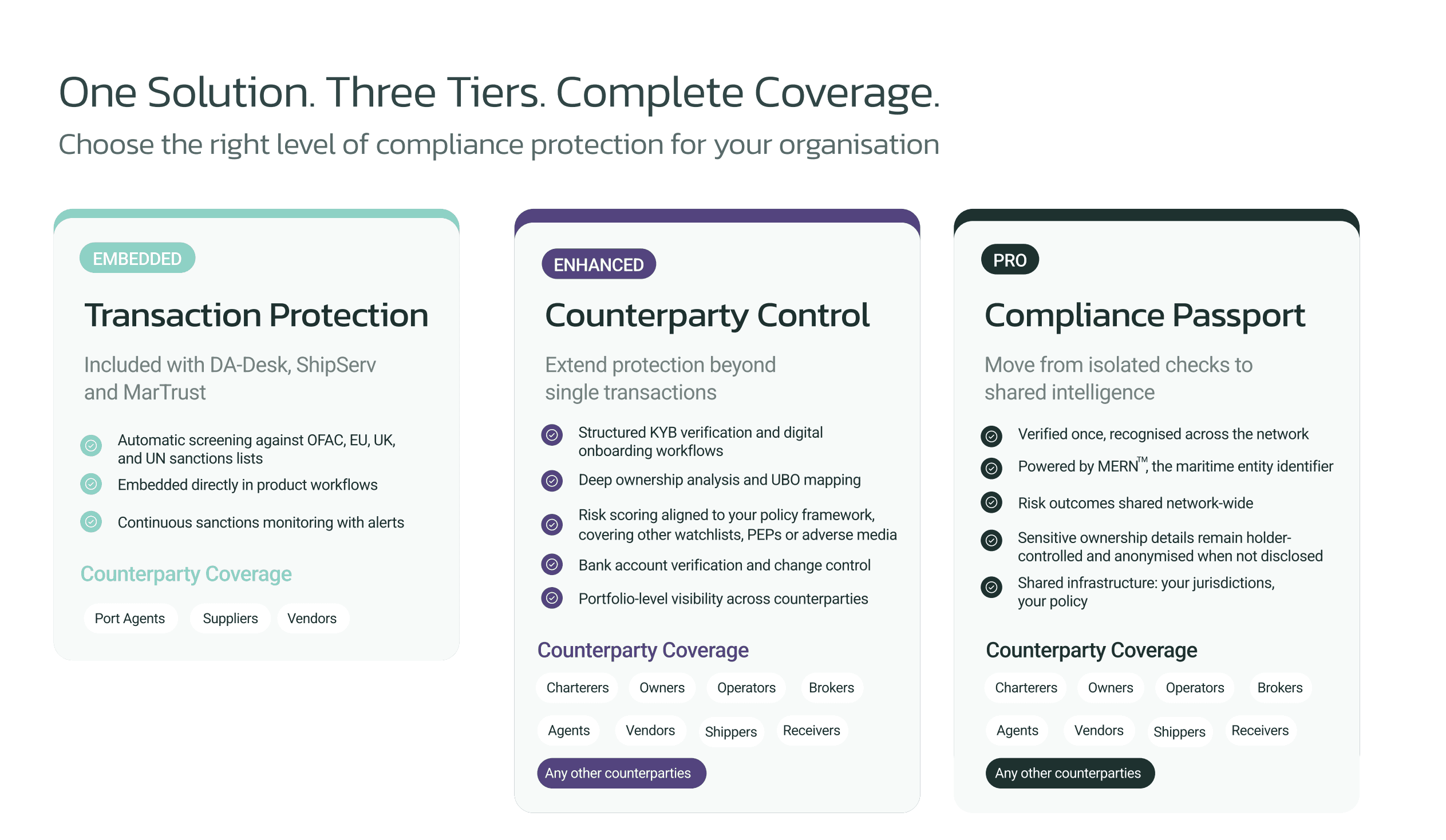
Organisations sit at different points along a spectrum depending on their risk appetite and operational capabilities.
At one end, shared verification may act as a trusted data layer, feeding screening results into internal processes while compliance teams retain control over policy decisions.
At the other end, organisations may adopt managed compliance workflows, where screening, alert resolution and monitoring are delegated to specialist providers operating within defined policy frameworks.
Most organisations sit somewhere in between. They begin with shared screening data, expand to managed workflows for higher-risk counterparties and gradually increase delegation as governance and confidence mature.
Building Toward a “Compliance Passport”
Our long-term goal is building toward a single “compliance passport” where a commercial counterparty is verified once and trusted across workflows through a unified framework. That credential moves with the transaction, continuously monitored to ensure screening and ownership checks remain current.
For this to work, it must be grounded in real operational data.
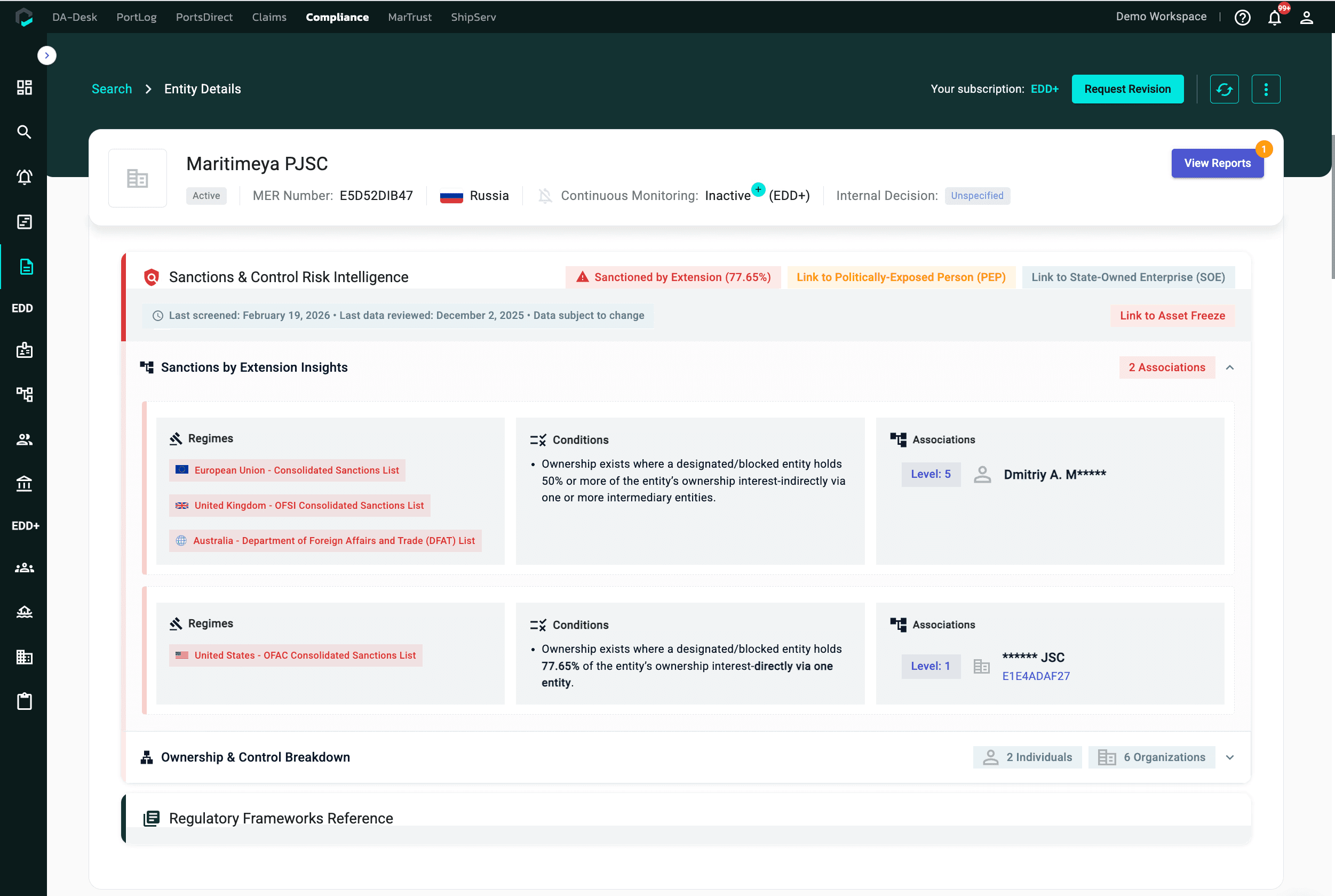
Marcura’s platforms, DA-Desk, ShipServ and MarTrust, have processed maritime transactions for over two decades, creating a mapped network of counterparties, legal entities and commercial relationships. That depth matters. Sanctions evasion does not hide in company names; it hides in ownership layers and transactional patterns.
Embedding compliance at the point of transaction is critical. When screening runs automatically during agent nominations, supplier onboarding or payment instructions, protection becomes part of the workflow rather than a parallel process.
This is not about adding more alerts. It is about sequencing intelligence properly, detecting material risk, reducing noise, and embedding outcomes into operations with clear governance and audit trails.
The solution is not more tools, but better coordination.
Compliance as shared infrastructure offers a path toward predictable protection — where verification is performed once, recognised across workflows, and reinforced by collective intelligence rather than repeated in isolation.
That is how the industry can move from fragmented effort to shared infrastructure, and build resilience into day-to-day operations.
“Using the Marcura platform has allowed us to scale without adding to the team.” Bianca Knight, General Manager, Commercial Claims, Pacific Basin Shipping
Leading practitioners discuss weigh up the case for compliance as common infrastructure
Learn from the people living this everyday
Read more
recent news

See How Marcura Helps Maritime Compliance Teams Stay Ahead
Understanding the risks highlighted in our compliance report is one thing. Addressing them in your day-to-day operations is another.