Your next port call should be informed by your last 50.
Every port call generates operational insight. Costs, claims, exceptions, negotiations, performance patterns.
Marcura structures that data and serves it back to you as intelligence, so every decision going forward carries the weight of everything that came before.
Stop starting from scratch every time.
See what you paid, what happened and what it means before the next decision
Trusted by 950+ shipping companies transporting one third of global commodities trade
Most maritime organisations start over with every port call
Critical information already exists across:
Port cost management
Claims and disputes
Payments and compliance workflows
Operational notes and documentation
Each contains part of the picture. Very little connects.
So when the next decision arrives:
Context is rebuilt
Patterns go unseen
Negotiations lose leverage
The same risks repeat
Claims are harder to defend
The constraint isn't effort. It's structure.
Connected operational intelligence
When data is structured across workflows:
Past events are easier to reference and compare
Costs, payments and claims are understood together
Decisions carry forward full operational and financial context
Compliance is embedded into workflows, not handled separately
Each port call builds on the last. The advantage compounds
Maritime organisations are looking beyond simple digitisation toward ways of making operational information more usable and comparable.

Where Marcura sits
At the point where decisions, finance and risk meet
Marcura operates inside the execution layer of maritime operations
Where port calls are managed
Where payments are made
Where claims are defended
Where compliance decisions are applied
That's what allows operational and financial information to be structured and connected, so it can be referenced more easily in future decisions.
2.5M+
port calls providing the foundation for broader patterns and outliers to become visible, beyond the scope of any single voyage or team.
"Norden's philosophy is that the more pieces of information we can gather, the better trade we can make.
"That's why we use Marcura's DA-Desk, PortLog and other systems, and it's why we're willing to be first movers. Combining all those pieces of information is what makes you a good trader."
Jonas Pappot, Head of Business Finance, DS NORDEN
A direct conversation about your operational context
Most maritime teams already have the data they need. The challenge is making it usable when decisions need to be made.
If this is something you are evaluating, a short discussion with one of our experts can help clarify what structured intelligence could look like in your operational and commercial context.
Your next port call should be informed by your last 50.
Every port call generates operational insight. Costs, claims, exceptions, negotiations, performance patterns.
Marcura structures that data and serves it back to you as intelligence, so every decision going forward carries the weight of everything that came before.
Stop starting from scratch every time.
See what you paid, what happened and what it means before the next decision
Trusted by 950+ shipping companies transporting one third of global commodities trade
Most maritime organisations start over with every port call
Critical information already exists across:
Port cost management
Claims and disputes
Payments and compliance workflows
Operational notes and documentation
Each contains part of the picture. Very little connects.
So when the next decision arrives:
Context is rebuilt
Patterns go unseen
Negotiations lose leverage
The same risks repeat
Claims are harder to defend
The constraint isn't effort. It's structure.
Connected operational intelligence
When data is structured across workflows:
Past events are easier to reference and compare
Costs, payments and claims are understood together
Decisions carry forward full operational and financial context
Compliance is embedded into workflows, not handled separately
Each port call builds on the last. The advantage compounds
Maritime organisations are looking beyond simple digitisation toward ways of making operational information more usable and comparable.
Where Marcura sits
At the point where decisions, finance and risk meet
Marcura operates inside the execution layer of maritime operations
Where port calls are managed
Where payments are made
Where claims are defended
Where compliance decisions are applied
That's what allows operational and financial information to be structured and connected, so it can be referenced more easily in future decisions.
2.5M+
port calls providing the foundation for broader patterns and outliers to become visible, beyond the scope of any single voyage or team.
"Norden's philosophy is that the more pieces of information we can gather, the better trade we can make.
"That's why we use Marcura's DA-Desk, PortLog and other systems, and it's why we're willing to be first movers. Combining all those pieces of information is what makes you a good trader."
Jonas Pappot, Head of Business Finance, DS NORDEN
A direct conversation about your operational context
Most maritime teams already have the data they need. The challenge is making it usable when decisions need to be made.
If this is something you are evaluating, a short discussion with one of our experts can help clarify what structured intelligence could look like in your operational and commercial context.
Your next port call should be informed by your last 50.
Every port call generates operational insight. Costs, claims, exceptions, negotiations, performance patterns.
Marcura structures that data and serves it back to you as intelligence, so every decision going forward carries the weight of everything that came before.
Stop starting from scratch every time.
See what you paid, what happened and what it means before the next decision
Trusted by 950+ shipping companies transporting one third of global commodities trade
Most maritime organisations start over with every port call
Critical information already exists across:
Port cost management
Claims and disputes
Payments and compliance workflows
Operational notes and documentation
Each contains part of the picture. Very little connects.
So when the next decision arrives:
Context is rebuilt
Patterns go unseen
Negotiations lose leverage
The same risks repeat
Claims are harder to defend
The constraint isn't effort. It's structure.
Connected operational intelligence
When data is structured across workflows:
Past events are easier to reference and compare
Costs, payments and claims are understood together
Decisions carry forward full operational and financial context
Compliance is embedded into workflows, not handled separately
Each port call builds on the last. The advantage compounds
Maritime organisations are looking beyond simple digitisation toward ways of making operational information more usable and comparable.
Where Marcura sits
At the point where decisions, finance and risk meet
Marcura operates inside the execution layer of maritime operations
Where port calls are managed
Where payments are made
Where claims are defended
Where compliance decisions are applied
That's what allows operational and financial information to be structured and connected, so it can be referenced more easily in future decisions.
2.5M+
port calls providing the foundation for broader patterns and outliers to become visible, beyond the scope of any single voyage or team.
"Norden's philosophy is that the more pieces of information we can gather, the better trade we can make.
"That's why we use Marcura's DA-Desk, PortLog and other systems, and it's why we're willing to be first movers. Combining all those pieces of information is what makes you a good trader."
Jonas Pappot, Head of Business Finance, DS NORDEN
A direct conversation about your operational context
Most maritime teams already have the data they need. The challenge is making it usable when decisions need to be made.
If this is something you are evaluating, a short discussion with one of our experts can help clarify what structured intelligence could look like in your operational and commercial context.
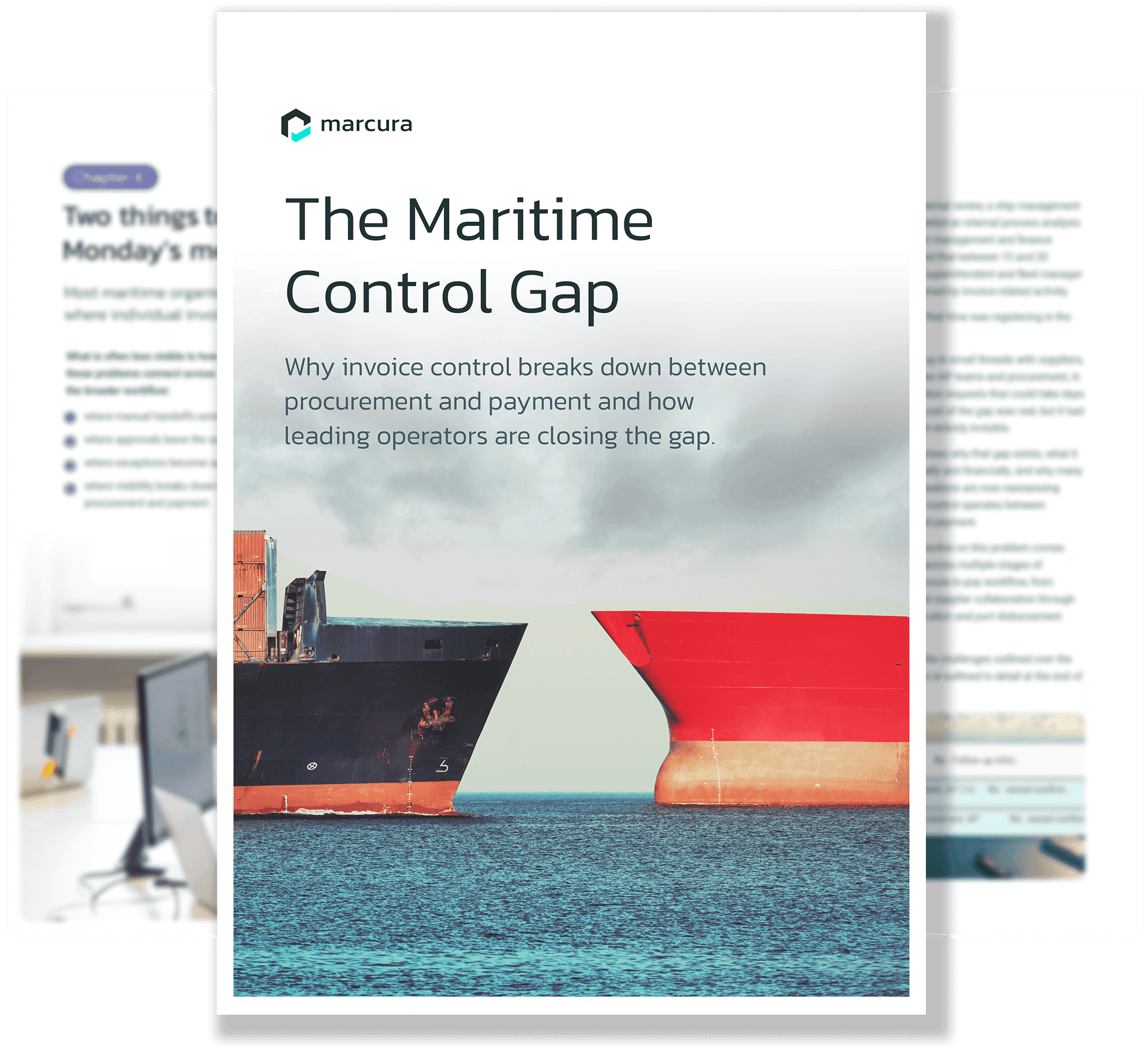
New guide
Take control of Procure-to-Pay
Why invoice control breaks down between PO and payment — and how leading ship managers close the gap. Free guide, plus two diagnostic tools.

Company
Legal
Contact
Accreditations




Company
Legal
Contact
Accreditations
Company
Legal
Contact
Accreditations
Company
Legal
Contact
Accreditations