
From addressing one of shipping's longstanding sources of frustration to building one of the industry's largest networks of maritime transactions, suppliers and counterparties, Marcura's founding ambition has remained remarkably consistent.
Founded in 2001, Marcura helps shipping companies protect voyage profitability and control the cost of operating their vessels. From the start, it set out to change the way work gets done in shipping, freeing maritime professionals to focus on the decisions that drive commercial performance.
It began with addressing one source of frustration: the management of port disbursement accounts. But the ambition was always much broader.
Twenty-five years later, founders Christian Haunsø and Jens Poulsen, early customer Christian Vinther Christensen and Group CEO Henrik Hyldahn reflect on the journey so far, the relationships that have shaped Marcura and the opportunities that lie ahead.
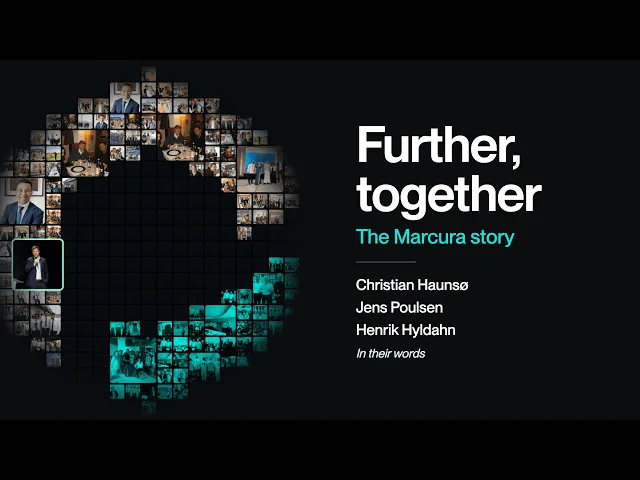
Getting ahead of the ship
The idea for Marcura came from Christian Haunsø's first-hand experience of working in shipping.
Responsible for a fleet of 17 mini bulkers making around 900 port calls a year, Christian was confronted with a constant stream of paperwork from ports around the world, often in different languages.
“You get a stack of paper from all sorts of ports in different languages. And you have to try and find out what really matters. So you're trailing the ship.”
For Christian, the problem went beyond paperwork. Shipping professionals are asset managers, responsible for valuable ships, the risks attached to them and the returns they generate. Yet much of their expertise was being consumed by routine administrative work.
“That load keeps capable people away from work that matters. Our vision was to change that. That's how we started DA-Desk.”
The aim was to let them act as asset managers again:
“Instead of swimming in the paperwork behind the ship, you want to be ahead of the ship and actually pre-empt and manage risk and returns in front of it.”
Building with the industry
Working closely with customers has shaped Marcura's development from the beginning. That spirit of co-creation helped extend its capabilities into areas including maritime payments and port intelligence through MarTrust and PortLog.
In 2018, Christian Haunsø and Jens Poulsen visited the offices of Danish shipping company NORDEN. At the time, Christian Vinther Christensen was grappling with a recurring disconnect between budgeted and actual voyage costs.
The conversations helped shape the development of PortLog, turning historical port-call information into commercial knowledge that could inform future voyage decisions.
“When you have a meeting of minds, meeting of culture, meeting of strategies, then there is a good chance that you will develop something together.
“Finally, someone who understood the problems I had, or we had, and someone who actually engaged in solving them.”
The relationship illustrates an approach that has served Marcura throughout its history: start with a real commercial problem, understand it in depth and work with the people who experience it to find a better way.
From DA-Desk to a connected maritime business
The acquisition of ShipServ in 2023 marked an important chapter in Marcura's development, bringing together two businesses with longstanding relationships across the maritime industry.
For Henrik Hyldahn, the similarities between the businesses became apparent through conversations with Marcura's founders. Their understanding of customer problems and their vision for the role ShipServ could play in addressing them helped establish a shared direction.
“The way that they talked about how they solved the client problems, how they built it, how they could see the role for ShipServ in that kind of environment. It felt so real"
Through customer-led development and strategic acquisitions, Marcura has brought together many of the most established brands in maritime: DA-Desk, PortLog, Claims, ShipServ, VesselMan, MarTrust and Brightwell.
Each addresses different aspects of shipping, but the underlying commercial challenges are often connected.
Shipping loses money in the gaps between estimated and actual costs, agreed terms and invoices, purchases and deliveries, and operational events and the claims that follow.
Closing those gaps is where Marcura creates value.
What does Marcura do today?
Marcura helps shipping companies protect voyage profitability and control the cost of operating their vessels.
Through Marcura Voyage and Marcura Vessel, we help customers plan, execute and settle commercial commitments, covering everything from port costs and contractual risks to procurement, vessel services and claims.
Marcura Voyage is for commercial operators and traders. It helps protect voyage profitability, from the first commercial decision to the final payment. Its capabilities span pre-fixture decisions, port-call execution, laytime, demurrage and claims.
Marcura Vessel is for shipowners and ship managers. It helps them control the cost of operating their vessels, keeping expenditure in line with their policies and quality expectations. Its capabilities span maritime procurement, husbandry, technical projects and crew payments.
Across both, Marcura combines technology, automation and specialist maritime expertise to carry commercial decisions through to their intended outcomes.
The Marcura Platform: connecting the dots
At the heart of Marcura is a platform built on one of the industry's largest networks of maritime transactions, suppliers and counterparties.
Today, that scale encompasses:
More than 200,000 port calls annually.
55,000 suppliers and 11,000 agents.
More than 150,000 seafarers paid each month.
Over US$17 billion processed annually under financial regulation.
The opportunity lies in putting that industry-wide scale to work for individual shipping companies.
The Marcura Platform connects customers' own systems to the wider maritime industry, bringing together three distinct advantages.
Network reach. Customers can find, assess and work with counterparties across a global maritime network, drawing on established commercial relationships and the purchasing advantages of scale.
Commercial knowledge. Decades of maritime transactions and operational experience help customers better understand costs, risks and counterparties. They can draw on that knowledge alongside their own commercial terms and history, while their confidential information remains private.
Trusted execution. Technology, specialist expertise, embedded compliance and regulated payments help customers carry commercial commitments through to settlement, with the appropriate controls in place.
The greater opportunity lies in connecting these capabilities.
Consider a single port call. For a commercial operator, it generates costs, contractual obligations and potentially claims. For a shipowner or ship manager, it may involve purchasing supplies, arranging services and managing technical work.
Different teams may manage these activities in different systems, yet much of the underlying information is the same: the vessel, the port, the counterparties, the agreed terms and the evidence of what happened.
By connecting more of this work, Marcura can help customers reduce repeated checks, carry information and controls from one commercial activity to the next, and use the outcome of each transaction to inform future decisions.
As Henrik Hyldahn explains:
“Whenever you take the size of the platform, understand the patterns, understand the users, understand the counterparts, you can start really connecting the dots. Things really accelerate.”
The ambition is to improve the terms on which shipping companies do business and reduce the work involved in doing so, while leaving commercial control firmly in their hands.
What comes next for Marcura?
The opportunity for Marcura's next chapter lies in connecting more of the work that takes place across voyage and vessel operations.
While the technology available to shipping has changed considerably since 2001, our founding ambition remains unchanged.
We take on the work that doesn't require our customers' judgement, while giving them the knowledge to make better commercial decisions. Those decisions remain theirs.
The next 25 years
The technologies available to shipping have changed considerably since Marcura was founded. The opportunities to remove unnecessary work, connect commercial processes and improve decision-making are greater than ever.
But technology alone is not the answer. Marcura's strength lies in combining it with a deep understanding of shipping, payments and vessel operating expenditure.
As Henrik puts it, Marcura is “a technology company built for shipping”.
The opportunity for the next chapter is to bring the advantages of industry-wide scale to the operations of individual shipping companies, connecting more of the work that takes place across voyage and vessel operations.
The founding ambition remains unchanged.
We take on the work that doesn't require our customers' judgement, while giving them the knowledge to make better commercial decisions. Those decisions remain theirs.
Twenty-five years on, there is still much more to do.
Further, together.


