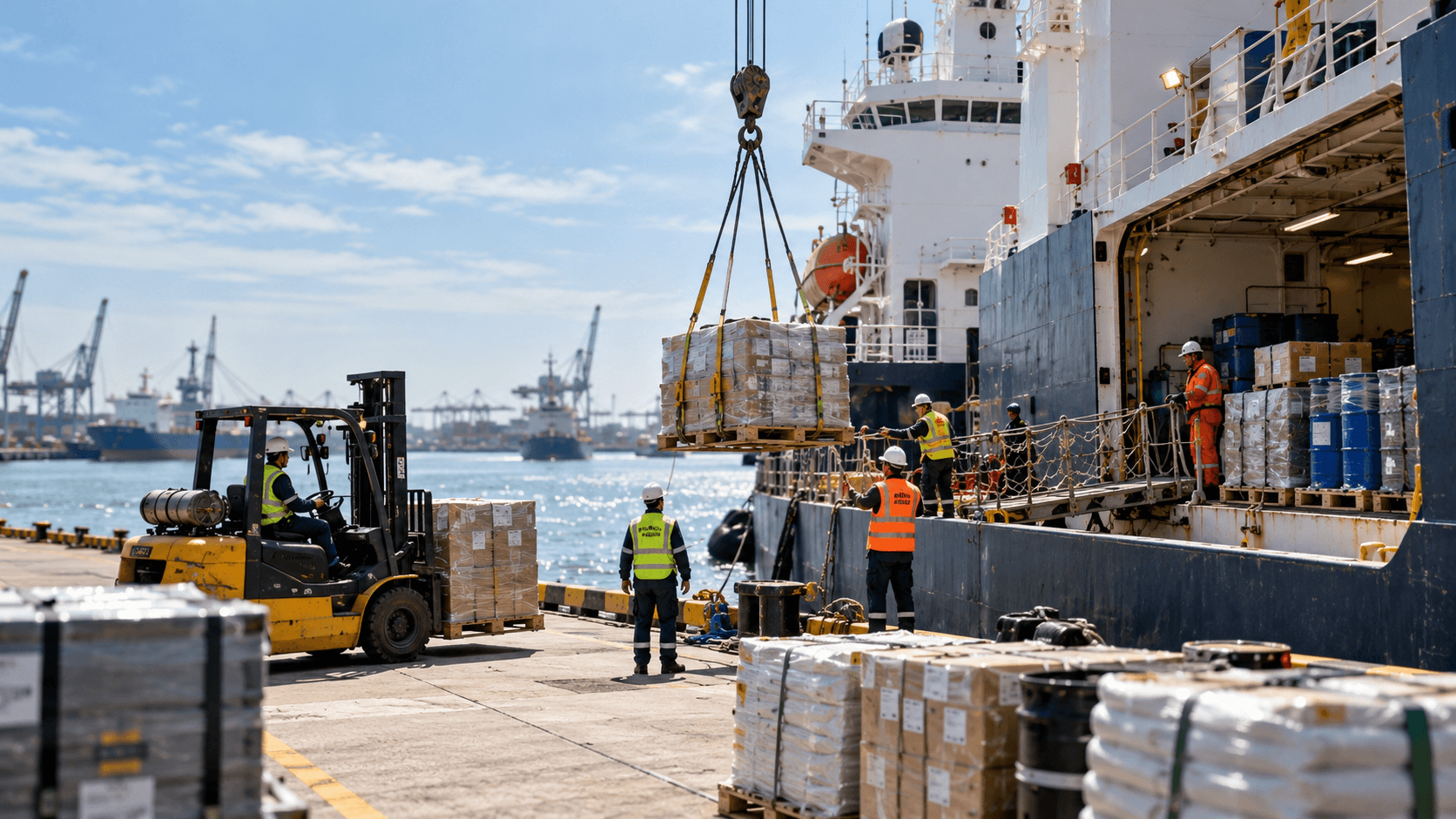
Project cargo stevedoring costs are the charges for loading, discharging and handling individual parcels of oversized or heavy-lift cargo, built per tonne, parcel, lift, gang, shift or hour. They can only be estimated from a parcel list — weights, dimensions, lifting points and handling sequence. The common misconception is that tonnage predicts the cost: two voyages of identical tonnage can be priced very differently depending on how the parcels are handled
Stevedoring for project cargo is hard to estimate, hard to check and hard to recover costs on, for one reason: the cost sits in the parcels and how they are handled.
Every stage of a voyage depends on that same parcel-level detail. Shipping loses money in the gaps between estimated and actual costs, agreed terms and invoices, and operational events and the claims that follow. A project cargo voyage is susceptible to all three at once.
The Marcura Voyage Solution connects voyage planning, procurement, port-cost control, compliance, payments and claims across the voyage. Following one voyage from fixing to settlement shows where the gaps open, and how that connection closes them.
How is stevedoring priced for project cargo?
Take a voyage carrying 25 parcels of industrial equipment. Five are heavy lifts that need a floating crane. Eight need specialist rigging. The rest can be handled with shore equipment.
What will the stevedoring cost? Tonnage alone rarely answers this question. The price follows the parcels: how many there are, what type, their dimensions and weight, their lifting points and stowage position, the order they are handled in, the crane capacity and specialist equipment each one needs. Charges are then built per tonne, parcel, lift, gang, shift or hour. Overtime, standby time, minimum gang commitments and any change to the lifting sequence push the total higher.
Basis of charge | What it is priced against |
Per tonne | The weight of the cargo handled |
Per parcel | The number and type of parcels |
Per lift | Each crane movement |
Per gang | The labour deployed, subject to minimum gang commitments |
Per shift | Each shift worked, including any additional shift |
Per hour | Time on the job, including overtime and standby |
Each of those is a point where the estimate and the final invoice can drift apart. Here is the voyage, stage by stage with an explanation of how Marcura closes those gaps.
How do you estimate stevedoring costs before fixing?
The operator builds the estimate from the parcels themselves. PortLog's stevedoring estimator works at parcel level. For each one it takes the weight and dimensions, the crane and lifting equipment required, and its place in the loading or discharge sequence. It also takes the gang, shift and overtime assumptions, terminal storage and internal transport, and the likely standby and waiting time.
The output is an estimate of stevedoring cost, the likely port stay, and the interruptions that would add standby, overtime and vessel costs. The operator tests different handling assumptions and arrives at a more realistic estimate before committing to the port call.
How do you compare stevedore and crane quotations?
With the parcel list agreed, the operator sends it to stevedores, crane providers and surveyors, together with the operating assumptions. Every supplier responds to the same job. That lets the operator compare the full cost of each proposal: crane hours, gang rates, overtime, standby charges, minimum commitments and equipment exclusions.
The agent, terminal, stevedore, crane provider and payment beneficiaries are screened before anyone is appointed. The chosen quotation and its scope stay attached to the port call, the invoice and the approval, so the final account has something specific to be checked against.
What does a changed discharge sequence cost?
The cargo receiver changes the discharge sequence. The floating crane stays on standby. An additional gang shift is required. Three parcels move into temporary storage.
Each of those costs arrives because the plan changed, and each will reach the final account as a line item. What the change costs depends on which parcels moved, which crane was waiting and which shift it landed in. Tonnage tells you none of that.
DA-Desk checks the resulting charges against the quotation and the parcel-level operating record. An unsupported equipment charge is challenged before payment. Validated costs are approved, and funds are released to validated parties with visibility over prefunding, payments, final costs and outstanding balances.
Can an operator recover the cost of a changed discharge sequence?
The same change creates a claim. Standby time, the additional shift and the storage costs are linked to the contractual responsibilities behind them. Whether they can be recovered depends on the contractual arrangements and the evidence: the charterparty terms, the Statement of Facts, the notices, the invoices and the operational record. Incomplete evidence or a missed contractual deadline makes a valid entitlement harder to recover.
The operator identifies the claim earlier, prepares a supported claim and tracks the recovery through to settlement with Marcura Claims.
The completed voyage leaves a record of what was estimated, what was spent and what was recovered, and that record informs the next estimate.
What does joined-up voyage cost control change?
The receiver decides the discharge sequence. The operator decides how the change is priced, checked and recovered. On this voyage that meant an estimate built from the parcels, quotations that could be compared, counterparties screened before appointment, an equipment charge challenged before payment, and a claim built on evidence.
What connects those steps is the information that moves between them. The parcel list that built the estimate becomes the basis for the quotations. The chosen quotation and its scope become the reference the final account is checked against. The operating record becomes the evidence for the claim, and the settled claim goes back into the next estimate.
The Marcura Voyage Solution helps the operator estimate complex stevedoring costs, procure the right services, validate counterparties, control payments and recover additional costs. Behind every step sits the same network of counterparties and the experience of more than 200,000 port calls a year, applied alongside the operator's own terms and history, which stay private to that operator.
The result is better visibility from parcel planning to final recovery, stronger cash-flow control and greater protection of project margin.
The decisions stayed with the operator. The work in the gaps was done for them.

Janani Yagnamurthy
SVP, Product, Strategic Growth