In this report
An impossible equation: How rising regulatory complexity, conflicting screening results, duplicated verification and limited headcount squeeze compliance teams from all sides.
Teams under pressure: What operations directors said about keeping up with financial crime compliance changes, manual due diligence and undetected risk.
How leaders are responding: How leading maritime organisations are responding, with perspectives from Pacific Basin, Enesel Group, Emirates Shipping Line and the Maritime Anti-Corruption Network.
Shared standards: The case for a new approach to compliance built around shared standards and collective learning.
The Fragmentation Problem in Maritime Compliance is Marcura's 2026 report on the pressure facing maritime compliance teams. In its maritime compliance survey of operations directors and senior maritime leaders, 82% say compliance is a growing demand in their role. Marcura frames fragmentation as the problem to solve: systems that don't talk to each other and knowledge that doesn't travel.
82%
say compliance is a growing demand in their role
86%
are concerned about compliance gaps and undetected risks
72%
struggle to complete all required KYC and FCC checks
Source: Marcura, The Fragmentation Problem in Maritime Compliance (2026). Survey of operations directors and senior maritime leaders.
Key findings
Respondents report growing compliance demands and concern about gaps. In Marcura’s survey, 82% say compliance is a growing demand in their role, and 86% are concerned about compliance gaps and undetected risks.
Many respondents struggle to complete all required checks. 72% struggle to complete all required KYC and financial crime compliance (FCC) checks, and 71% say manual due diligence consumes too much time.
The report puts a hidden cost on onboarding. It puts the combined internal cost of onboarding and KYC at an estimated $1,500–$3,500 per counterparty.
Marcura sees sanctions exposure as layered. It argues that US, UK and EU regimes, closely coordinated against Russia in 2022, are now diverging, and that enforcement reaches through ownership and control.
The report describes a shadow fleet that adapts. Citing Clarksons Research, it puts the shadow fleet at 1,578 ships, and says the fleet reappears under new flags as registries strike vessels off.
The report widens the risk picture beyond sanctions. It covers payment fraud, supplier standards and corruption, citing over 70,000 corruption-related reports documented by the Maritime Anti-Corruption Network (MACN) from more than 1,000 ports across 150 countries.
Marcura sees AI as a triage and interpretation tool. It says that in operational settings AI adds most value at first-line triage and interpretation, and that full automation is “neither possible nor desirable”.
What does Marcura’s maritime compliance survey show?
The maritime compliance survey in Marcura’s report gives six figures under three labels: the burden, the anxiety and the drag. Marcura asked operations directors and senior maritime leaders about their compliance challenges. In the report’s reading, the answers show a workforce under strain, struggling to keep pace with regulatory change and losing time to manual processes.
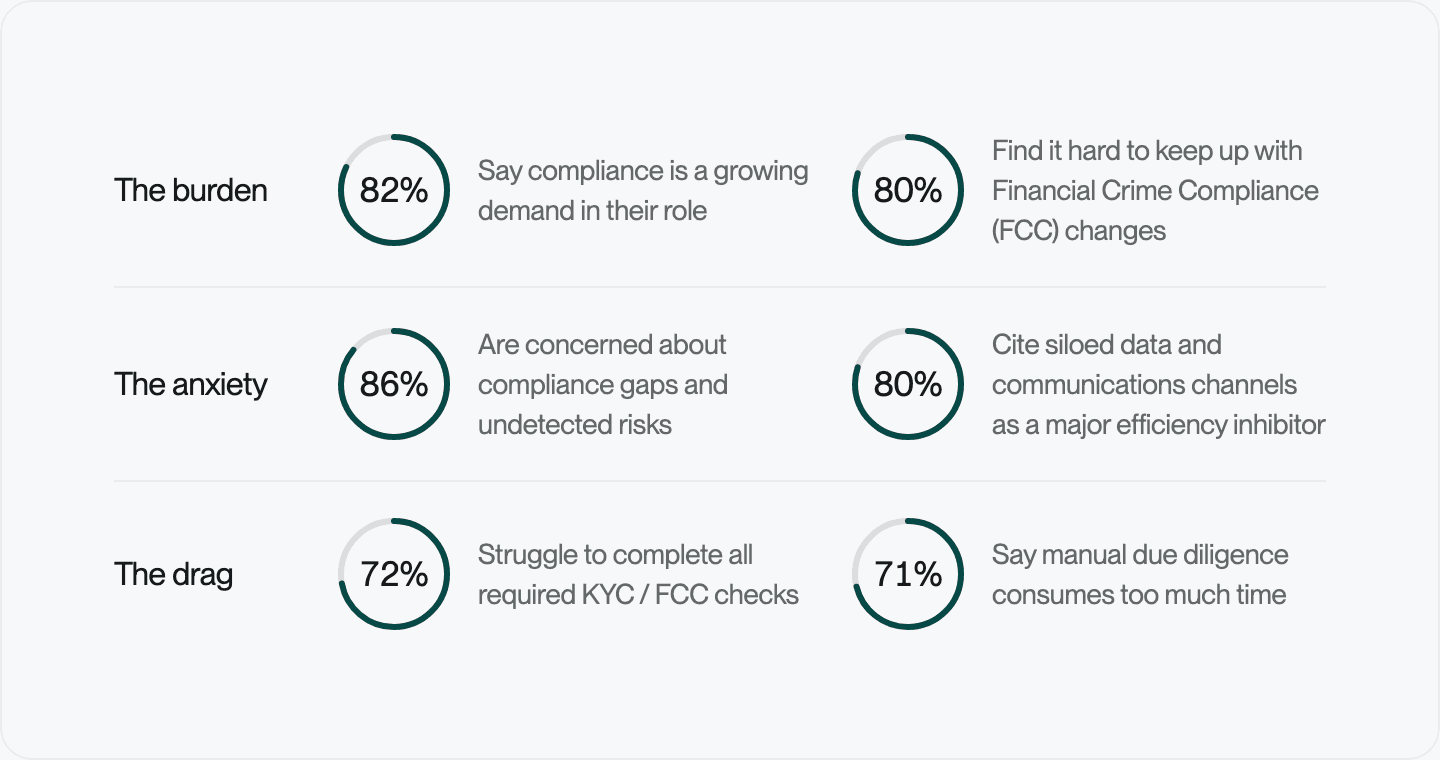
Exhibit 1: Six survey figures under the report's three labels: the burden, the anxiety and the drag. Each figure is a separate statement. Source: Marcura, The Fragmentation Problem in Maritime Compliance (2026), survey of operations directors and senior maritime leaders.
The burden: 82% say compliance is a growing demand in their role, and 80% find it hard to keep up with FCC changes.
The anxiety: 86% are concerned about compliance gaps and undetected risks, and 80% cite siloed data and communications channels as a major efficiency inhibitor.
The drag: 72% struggle to complete all required KYC and FCC checks, and 71% say manual due diligence consumes too much time.
How much does counterparty onboarding and KYC cost
Marcura’s report puts a price on counterparty onboarding and KYC. It puts the combined internal cost of onboarding and KYC at an estimated $1,500–$3,500 per counterparty. In fragmented markets like dry bulk, where “every other business opportunity requires onboarding someone new”, Marcura’s authors write that the resource drain becomes structural.
Why is maritime sanctions compliance getting harder?
According to Marcura’s report, maritime sanctions compliance is getting harder because the main Western regimes no longer move together. When US, UK and EU sanctions coordinated closely against Russia in 2022, compliance teams built frameworks around a shared risk perimeter: screen against the US Office of Foreign Assets Control (OFAC), apply conservative controls, and exposure would generally align. That assumption is weaker today, Marcura says, and divergence now reflects differences in strategy, enforcement and jurisdiction.
In the report’s account, the US has kept strict liability and secondary sanctions while placing greater emphasis on Iran alongside Russia, and the EU keeps expanding its Russia-focused measures. The practical result, it says, is several regulators applying different rules to the same transaction: trading in dollars places a company under OFAC jurisdiction. Employing EU nationals creates EU obligations, it adds, even for a company based in Asia. Compliance exposure, in the report’s words, “is no longer singular. It is layered.”
“Today you have sanctions regimes from different authorities that don't always align. As compliance officers, we have to decide which regimes we're going to abide by, in addition to, of course, adhering to our own regulatory authority's requirements.”
Senior compliance officer
,
Global commodities trading house
What is indirect sanctions exposure
Indirect sanctions exposure, in Marcura’s report, comes from companies that don’t appear on a sanctions list but are still restricted, “effectively sanctioned by extension”, because a designated person owns or controls them. In maritime, Marcura says, this risk sits beneath the surface: vessels are held through layered structures and special purpose vehicles (SPVs), charterers may operate through newly formed entities, and a counterparty’s “full style” identifies the contracting entity but “rarely shows who ultimately owns or controls it”.
Marcura’s conclusion is that screening the named counterparty is no longer enough. Compliance, it argues, requires identifying ultimate beneficial owners and mapping control structures.
How has sanctions enforcement changed
Regulators now expect organisations to identify and manage sanctions risk before transactions occur, according to Marcura’s report, and authorities are pursuing wilful blindness cases more actively. “Ignorance is not a defence when risk was discoverable.” The report calls static or periodic screening “increasingly insufficient”, and expects secondary sanctions to expand and beneficial ownership verification expectations to tighten.
What is the shadow fleet and why does it matter to legitimate operators?
Marcura’s report describes the shadow fleet as a parallel shipping infrastructure that exists to move cargo that cannot move through legitimate channels. Citing Clarksons Research, it puts the fleet at 1,578 ships. Elsewhere it describes more than 1,500 vessels operating in opaque networks, many linked to sanctioned trade, though not all are designated. For legitimate operators, it argues, the exposure is twofold: regulatory and physical.
1,578
ships in the shadow fleet
3.7m
estimated barrels of oil a day moved by Russia's shadow fleet
65%
of Russia's seaborne oil trade, estimated
Sources as cited in Marcura's report: Clarksons Research (fleet size); Center for Strategic and International Studies (CSIS) estimates for Russia's shadow fleet (barrels and share).
The two CSIS estimates above describe Russia’s shadow fleet. According to CSIS analysis, as cited in Marcura’s report, that fleet generates an estimated $87bn to $100bn in annual revenue.
For charterers, Marcura’s report says, the regulatory risk is tangible: “Charter a vessel that has touched sanctioned trade, and OFAC may designate it tomorrow.” It warns that any contact with the shadow fleet risks consequences that cascade through insurance, banking and counterparty relationships, including exclusion from the US dollar payment system “if designated by OFAC”, multi-million-dollar fines and asset seizures. The second risk is physical. Marcura’s authors describe poorly maintained vessels “operating outside classification and insurance frameworks” that “share the same sea lanes as legally operated assets”.
How are regulators responding to the shadow fleet
Marcura’s report says more than 700 vessels were sanctioned across US, EU and UK actions in 2025 alone. Registries have struck vessels off, but in Marcura’s account the fleet reappears under new flags. Separately, a study by S&P Global in late 2025, cited in the report, found more than 370 vessels flying a false or fraudulent flag, up from 223 at the beginning of the year.
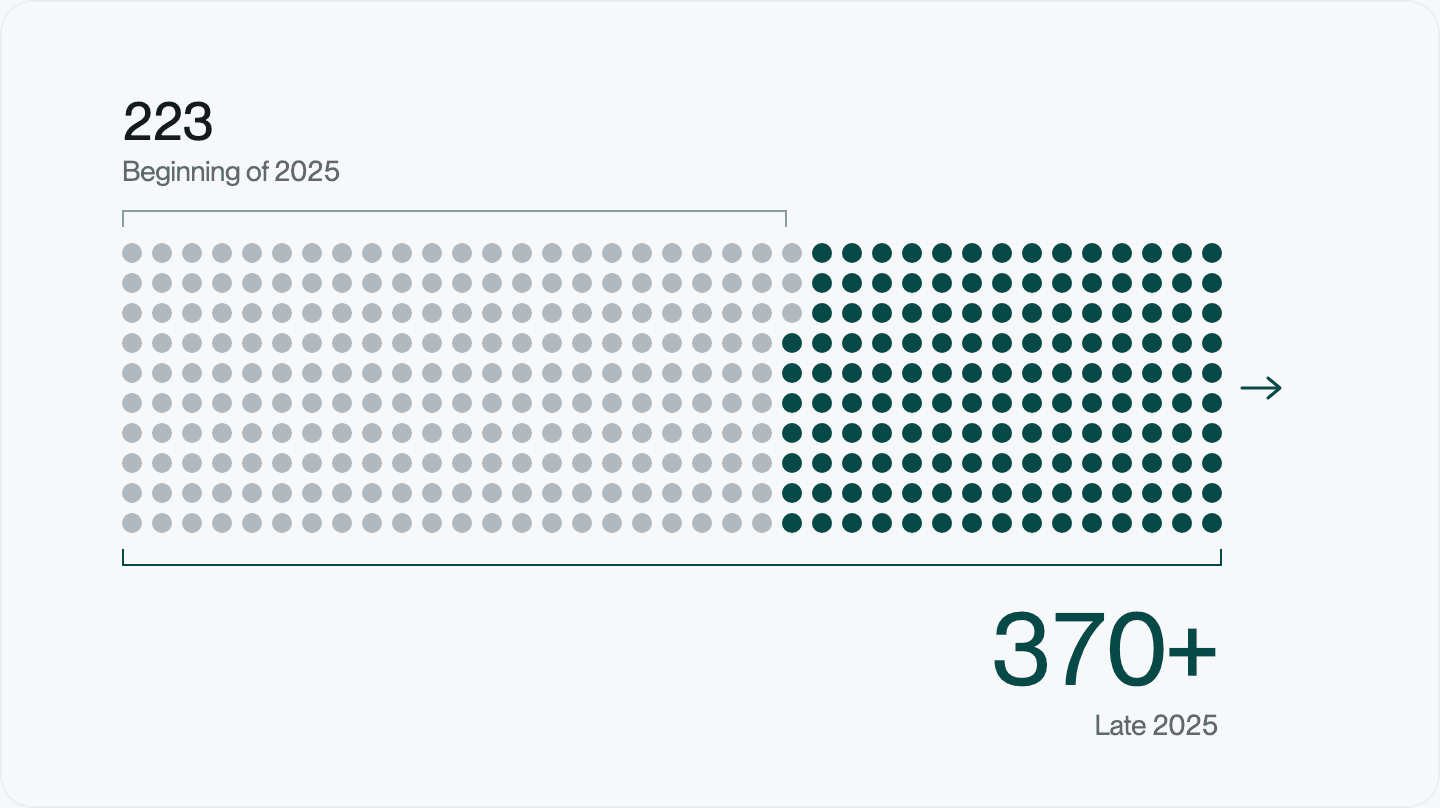
Exhibit 2: Vessels flying a false or fraudulent flag rose from 223 at the start of 2025 to more than 370 by late 2025. Each dot is one vessel; the late-2025 figure is a minimum. Source: S&P Global, as cited in Marcura, The Fragmentation Problem in Maritime Compliance (2026).
What compliance risks go beyond sanctions?
Beyond sanctions, Marcura’s report says maritime organisations are now expected to manage payment fraud, cybersecurity threats, supplier compliance, environmental obligations and anti-bribery controls. Each brings its own regulatory and financial exposure. In Marcura’s view, they increasingly draw on the same data, rely on the same verification processes, and fail in the same places when those foundations are weak.
Three risks beyond sanctions, as the report describes them
Risk | The report’s concern | Referenced |
|---|---|---|
Payment fraud | High-value payments, decentralised decisions | DNV |
ESG and supplier standards | Growing demand for ISO, ISM and Scope 3 evidence | Hong Kong Convention; IMO Net-Zero Framework |
Anti-bribery and corruption | No unified standard for assessing ABC risk | MACN |
Why is maritime more exposed to payment fraud
Maritime is more exposed to payment fraud because shipping combines high-value transactions with decentralised decision-making and limited bank verification infrastructure, Marcura’s report argues. Counterparties frequently change bank details for legitimate reasons, and vessel schedules create pressure to pay fast. Where retail banking might require secondary approval above a few hundred dollars, it says, maritime organisations process five-figure payments at first authorisation.
Citing DNV’s Maritime Cyber Priority 2024/25 report, Marcura says nearly a third of maritime professionals reported at least one cyber-attack in the twelve months to October 2024. The same chapter says business email compromise (BEC) and payment fraud targeting maritime organisations runs three to five times higher than traditional banking when adjusted for transaction volume.
A separate Marcura article looks at effective fraud controls for maritime payments in depth.
How are ESG rules changing supplier vetting
Marcura’s report argues that supplier vetting, traditionally focused on financial and sanctions risk, is expanding fast to cover environmental compliance, hazardous materials management and supply chain emissions. According to the report, the Hong Kong Convention, which entered force in June 2025, requires every vessel trading internationally to maintain an up-to-date Inventory of Hazardous Materials (IHM) throughout its operational life. Marcura’s article on IHM compliance under the Hong Kong Convention explains the requirement.
For procurement teams, the report says, the question now is whether a supplier can evidence environmental, safety and governance compliance “at the point of transaction, not months later when the leverage has gone”.
How much does corruption cost the food and bulk import industry in Nigeria?
In Nigeria, corruption costs the industry involved in importing food and bulk products more than USD 162 million a year, adding close to 15% to total transport and logistics costs, according to the Cost of Corruption Study (2024) by the Maritime Anti-Corruption Network (MACN), as cited in Marcura’s report. Per shipment, that amounts to USD 147,000 for grain and over USD 178,000 for petrol imports. The report presents Nigeria as a key case study for maritime import supply chains.
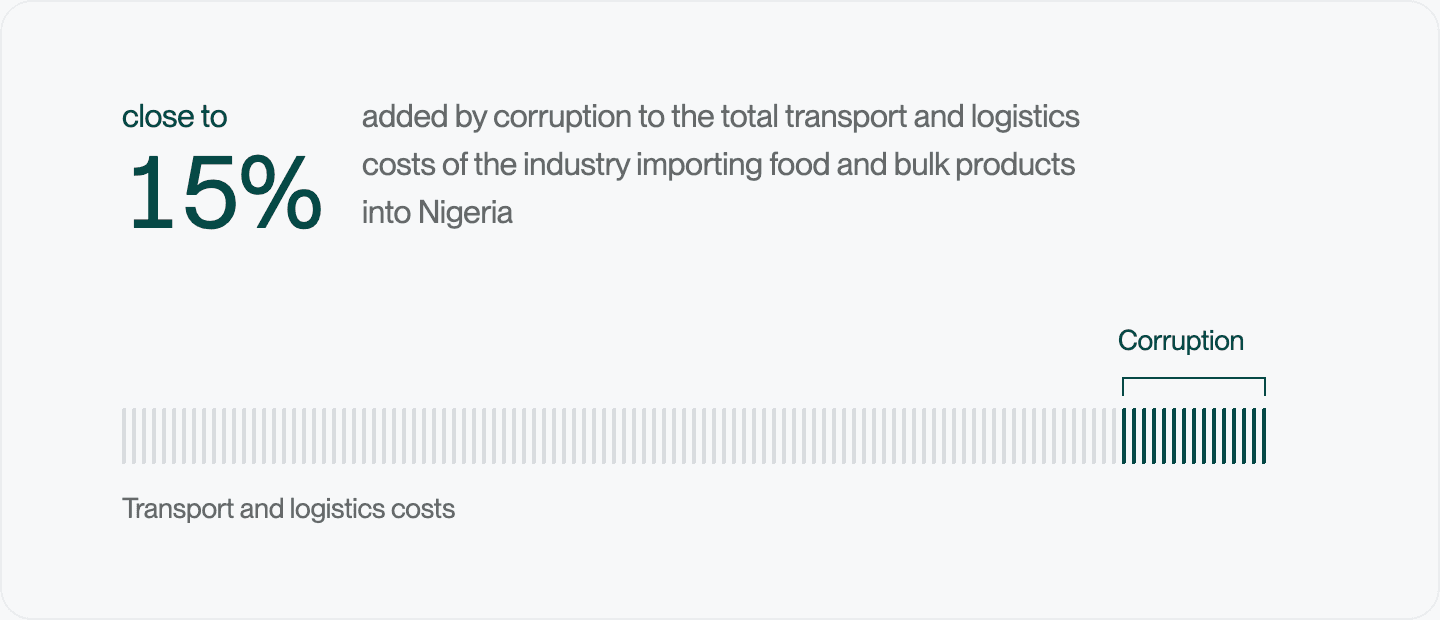
Exhibit 3: Corruption adds close to 15% to total transport and logistics costs for the industry importing food and bulk products into Nigeria. Source: MACN Cost of Corruption Study (2024), as cited in Marcura, The Fragmentation Problem in Maritime Compliance (2026).
MACN’s wider data, as the report states it, spans 150 countries. Since its founding in 2011, the network has documented over 70,000 corruption-related reports from more than 1,000 ports. In 2025 alone, MACN received 4,347 reports of extortion, often described as “gratuities”, which contravene international anti-corruption standards.
The IMO provides procedural guidance on handling corrupt demands, but no unified framework exists for assessing counterparty anti-bribery and corruption (ABC) risk, according to the report. Companies adopt their own question sets and interpret them according to what they consider material.
“Third parties remain one of the biggest sources of corruption risk, yet due diligence is often a paper exercise. Questionnaires are sent out, policies are uploaded, and boxes are ticked. That may demonstrate effort, but it does not necessarily change behaviour.”
Cecilia Müller Torbrand
,
CEO, Maritime Anti-Corruption Network (MACN)
Why does fragmentation make maritime compliance harder?
Fragmentation makes maritime compliance harder, Marcura’s report argues, because compliance risk is spread across every party to a voyage while the systems used to manage it don’t talk to each other. “Every voyage is a compliance event.” The vessel, the cargo and the counterparties at every stage, from charterers and brokers to agents, insurers and financiers, each carry risk. Each operates under different jurisdictions with different rules, and deals move fast.
Banking, in the report’s comparison, can isolate sanctions compliance to discrete checkpoints, with decisions flowing through centralised approval nodes before transactions clear. “Maritime has no such luxury.” Risk, it says, is dispersed across fragmented networks under compressed decision timelines.
Fieke Nijland of Emirates Shipping Line describes the squeeze in container shipping, where a single vessel might carry five thousand containers.
“You only fully know who the shipper is when cargo is presented at the port. That leaves very little time to complete due diligence before containers are loaded. If results come back too late and a problem cargo is already aboard, you're into mitigation territory.”
Fieke Nijland
,
VP, Legal Counsel, Emirates Shipping Line
Why do screening tools give different answers on the same counterparty
Different platforms return different results on the same counterparty, according to Marcura’s report: “One clears, another flags amber, a third returns inconclusive.” In the report’s account, organisations often use several screening platforms, sanctions databases, beneficial ownership tools, vessel tracking systems, and politically exposed person (PEP) and adverse media lists. With no orchestration layer, the compliance team becomes “the manual integration layer”.
A search on the company name can also look clean while missing shell companies, obscured beneficial ownership or vessel histories marked by extended dark periods, Marcura warns. “Sanctions evasion hides in corporate structures, not company names.”
What is supplier questionnaire fatigue
Marcura’s report describes questionnaire fatigue among suppliers: vendors complete the same information requests repeatedly for every customer, through different questionnaires, formats and portals. “Questionnaire fatigue sets in. Forms get completed carelessly. Data quality suffers.” The system, Marcura concludes, “demands maximum effort from everyone and delivers minimum collective benefit.”
Why doesn’t compliance knowledge travel
Knowledge sits in silos, Marcura argues, and teams look at the same counterparty repeatedly without realising it. When one organisation discovers a compromised supplier or a fraudulent payment pattern, that intelligence “stays locked inside their walls”. For commercial counterparty screening, the report says, organisations still largely operate in isolation, each bearing the full verification cost alone.
Where can AI help in maritime compliance?
According to Marcura’s report, AI adds most value in operational maritime compliance settings at first-line triage and interpretation, rather than final decision-making. Applied there, it reduces noise, surfaces meaningful risk signals and translates complex compliance outputs into language non-specialists can act on, while human oversight stays on high-stakes decisions.
The report describes two applications. In sanctions screening, when a counterparty generates hits across multiple regulatory lists, AI can assess the likelihood that the screened entity matches the sanctioned party, filtering out obvious false positives while escalating genuinely ambiguous cases for review. AI-generated summaries can also explain which regulatory regimes are triggered, why they matter and what they mean in practice for an organisation operating under US, EU or UK jurisdiction.
The report states that “Full automation is neither possible nor desirable”, and that regulators explicitly expect human judgement in high-stakes compliance decisions. It describes the realistic future as hybrid. In that future, AI handles routine screening, anomaly detection and risk quantification. Humans reserve judgement for ambiguous cases, emerging threat patterns, and decisions with material business or reputational consequences.
That, in Marcura’s view, frees human expertise for strategic risk management. Mike Gerasymov of Enesel Group gives a practitioner’s view of the pace of change.
“The reasons full automation won't happen quickly aren't technical. They're human: trust, resistance to change, and the practical question of which projects to prioritise first.”
Mike Gerasymov
,
Global Head of Corporate Risk, Enesel Group
How would shared compliance verification work?
In the shared model Marcura’s report proposes, a counterparty is verified once and that verification is recognised across workflows. Marcura calls this compliance as shared infrastructure: “Verification is performed once, recognised across workflows, and reinforced by collective intelligence that allows risks identified in one context to protect participants that contribute to it.”
The report pictures a trusted ecosystem running from commercial chartering through procurement to payment, where anyone entering is screened before participation. Screening integrated across that ecosystem, it says, catches what fragmented checks miss: ownership chains, related entities and transaction patterns that only become visible when data flows through a shared infrastructure. A separate Marcura article explores maritime compliance as shared infrastructure.
Bianca Knight of Pacific Basin Shipping says there isn’t an industry-wide standard for acceptable due diligence, and argues for a common baseline that brings in traders and bankers too.
“There needs to be transparency for there to be trust in it. We would need to understand who did the check, when it was done, what it was checked against.”
Bianca Knight
,
General Manager, Commercial Claims, Pacific Basin Shipping
What does Marcura’s maritime compliance report recommend?
Marcura’s maritime compliance report points organisations toward verification that is done once, built into the places where the business works, and shared. It doesn’t end with a numbered list of recommendations, so the points below are drawn from across its chapters.
Screen beyond the named counterparty. The report says compliance requires identifying ultimate beneficial owners and mapping control structures, and calls static or periodic screening “increasingly insufficient”.
Plan for sanctions as a permanent condition. Marcura says sanctions “have settled into a permanent instrument of foreign policy”, and that “future conflicts will generate fresh designations”.
Check suppliers at the point of transaction. The report frames the procurement question as whether a supplier can evidence environmental, safety and governance compliance when the transaction happens.
Use AI for triage and keep people on material decisions. In Marcura’s account, AI filters obvious false positives and explains outputs in language non-specialists can act on, while humans reserve judgement for ambiguous and high-stakes cases.
Agree shared due-diligence questions, then go further. MACN’s Cecilia Müller Torbrand argues that a shared set of relevant questions would reduce duplication, and that changing behaviour in high-risk markets also takes dialogue, trust and engagement.
Move toward shared infrastructure in steps. Shared infrastructure doesn’t require an all-or-nothing commitment, Marcura’s authors write. Organisations can start with screening data, expand to managed workflows for higher-risk counterparties, and shift toward fuller delegation as trust builds.
On alert overload, Andrei Grigoras, SVP, Compliance Solutions at Marcura, writes in the report’s foreword: “The fix is not more alerts, but smarter sequencing: reduce noise, score impact first, and embed outcomes into operations with governance and audit trails.”

How was Marcura’s maritime compliance report put together?
Marcura’s report draws its survey figures from operations directors and senior maritime leaders, asked about their compliance challenges. Marcura published the report in 2026, with a foreword by Andrei Grigoras, SVP, Compliance Solutions at Marcura, and announced it in a launch post for the report.
Alongside the survey, the report sets out Marcura’s arguments, supported by figures it attributes to named sources including Clarksons Research, CSIS, S&P Global, DNV and MACN. It also draws on conversations with Bianca Knight (Pacific Basin Shipping), Mike Gerasymov (Enesel Group), Fieke Nijland (Emirates Shipping Line) and Cecilia Müller Torbrand (MACN), and quotes an unnamed senior compliance officer at a global commodities trading house. The final chapter, and some inserts earlier in the report, describe Marcura’s own compliance products, and this summary doesn’t cover them.
For a discussion of the same themes, watch the webinar on why maritime compliance is fragmenting and what comes next.
FAQs
Related resources