Where Demurrage Actually Gets Lost: Four Patterns Inside the Claims Process
Most demurrage losses don't trace back to what happened at the port. They trace back to how the claims process handled things afterwards, and they follow four consistent, recoverable patterns.

By Joe Arko
VP of Sales, Marcura
Most demurrage conversations focus on the wrong end of the problem.
Port congestion, weather delays, terminal inefficiency. These are real, and plenty of exposure flows from conditions no claims team can control.
But a significant share of demurrage losses happen after the vessel sails, not during the port call itself. They happen in spreadsheets, disconnected systems, and analysts' heads.
According to estimates, dry bulk alone accounts for $8–10 billion in demurrage fees annually, roughly 6–8% of total freight spend. At rates of $15,000–$30,000 per day, every unrecovered hour has a real dollar value.
And because most demurrage claims teams are still running manual workflows that were never designed for today's volume, a meaningful portion of that entitlement simply doesn't get recovered.
How much time do demurrage analysts spend on administrative work?
Analysis across more than 20,000 claims processed annually shows approximately 75% of demurrage analyst time is absorbed by process tasks; document collection, chasing agents, entering SOF data, formatting calculations, filing correspondence. Only 25% goes to the work analysts were hired for: dispute handling, clause interpretation, and negotiation.
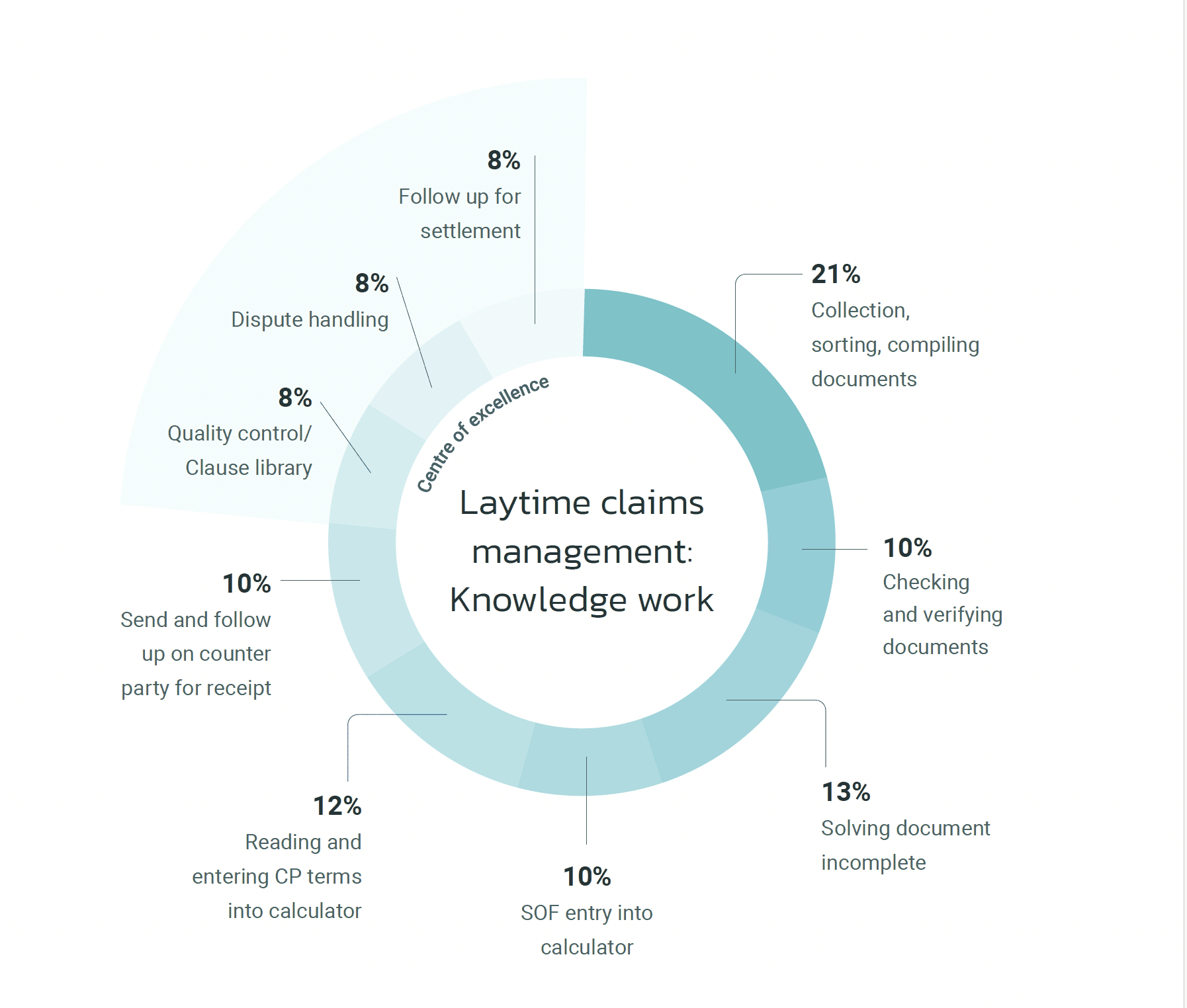
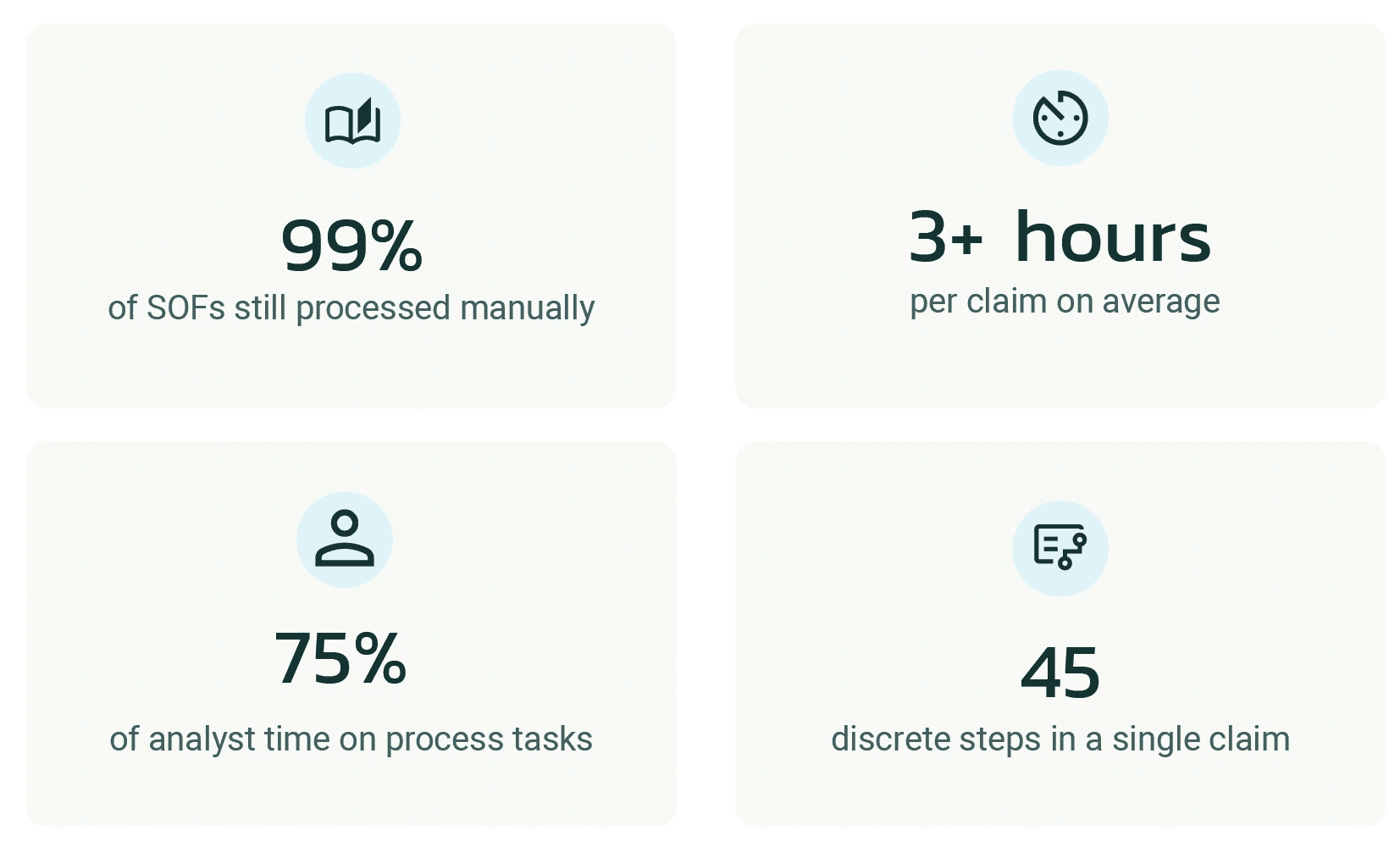
A single demurrage claim involves roughly 45 discrete steps.
The issue isn't capability. Most claims teams are experienced and have deep domain expertise. The issue is structural. 99% of statements of facts (SOFs) are still processed manually across the industry, consuming an estimated 12 million hours per year.
Under that kind of load, corners get cut, not deliberately, but inevitably.
What causes demurrage claims to lose money?
Demurrage leakage follows four consistent patterns across organisations of every size and commodity type, according to Marcura's experience processing claims across dry bulk, tankers, chemicals and project cargo.
Incomplete calculations. When volume is high and analysts are stretched, selective transcription becomes common. At $15,000–$30,000 per day, each unrecovered detail compounds across a portfolio.
Missed time bars. Miss a time bar and the claim is gone. When time bars live in analysts' heads or beside a spreadsheet, one absence or busy period can erase recoverable entitlement. One real portfolio documented $450,000 in time bar failures in a single year.
Data that can't be queried. SOFs exist, but not in a form that makes them useful for reporting. Leadership questions that should be simple queries become multi-week projects because the data wasn't captured in a way that makes them answerable.
Expertise that walks out the door. When a senior analyst leaves, the loss isn't just headcount. It's the knowledge of how a specific counterparty negotiates, the history of a disputed clause, the context behind decisions never written down. In a manual workflow, that institutional memory leaves with the person.
How do charter party clauses cause demurrage losses?
Charter party ambiguities account for 5–10% of total demurrage write-downs across the industry and can delay claim submission by 20–30 days. This is a source of leakage that receives less attention than the administrative burden, but compounds in the same way.
The practical consequences are significant. An early loading clause with ambiguous laycan language can cost approximately $70,000 per port call if laytime only commences from the agreed laycan regardless of when loading actually begins.
A vessel-on-demurrage clause that fails to exclude daylight restrictions can cost around $20,000 per call. An STS clause missing laytime start and end details creates the same exposure.
One organisation had a holiday clause in their standard terms, but it specifically referenced BIMCO holidays. When a vessel called at a port observing a local public holiday not on the BIMCO list, the charterer was liable for a day and a half of demurrage the clause should have covered.
The fix at renewal was a single word: removing 'BIMCO', so any recognised holiday is excluded from laytime. But identifying the problem required cross-referencing operational data against clause language, something a manual process rarely produces.
Structured claims data makes that connection available before the next fixture is signed.

Why Demurrage Needs a Human in the Loop
For all the promise of AI, laytime and demurrage management still needs a human in the loop
What does demurrage management software do, and how is it different from a laytime calculator?
A laytime calculator handles the calculation step. Demurrage management software handles the entire claims lifecycle from document collection through to analytics, and produces structured data that the business can actually use.
The more significant distinction, though, is between AI automation alone and AI automation with expert oversight. A pattern emerges among teams using AI-only laytime and demurrage tools: the workload does not disappear, it relocates.
LLMs aren't perfect. Document quality, scan angle, and handwriting legibility all affect output. Someone is still chasing the stamped original, still filling data gaps, still handling the exceptions the algorithm flagged but could not resolve. Automation alone is not sufficient.
Marcura Claims is a demurrage and laytime management platform used by shipowners, tanker operators, and charterers to process, track, and analyse claims. It combines technology, AI, and a specialist operations team.
Rather than starting with calculation, it starts with document collection: Marcura's Port Document Management Service (PDMS) tracks port calls using AIS data and initiates document collection automatically when a vessel sails, following up with agents until a complete, verified bundle is received.
A large language model trained on more than 600,000 SOFs then digitises and normalises every event in the statement of facts, not just the events that feed the current calculation, but everything. A specialist QA team then reviews and corrects the output before it enters the calculator, so outputs are accurate and defensible.
Time bars are tracked automatically. Every claim sits in a single shared record visible to the whole team. When an analyst leaves, the claim doesn't go with them.
What are the measurable benefits of structured demurrage management?
Teams using Marcura Claims have achieved a 50% reduction in processing time, a 7–8% reduction in overall demurrage spend, a 60% reduction in negotiation time, and a 20% improvement in FTE productivity, according to Marcura's published outcomes data.
Beyond efficiency, structured claims data becomes commercial intelligence. When every SOF event is captured and normalised, reporting becomes a query rather than a project. Claims teams can see which ports and terminals consistently drive outliers, which clauses generate disputes, and how specific counterparties behave across a broad population of claims.
Using claims data to inform future fixture negotiations
A counterparty that knows calculations are consistently accurate tends to settle faster, which directly improves demurrage recovery rates. An analyst who can show a counterparty's historical behaviour across hundreds of claims enters a negotiation with an edge no individual team's memory can replicate.
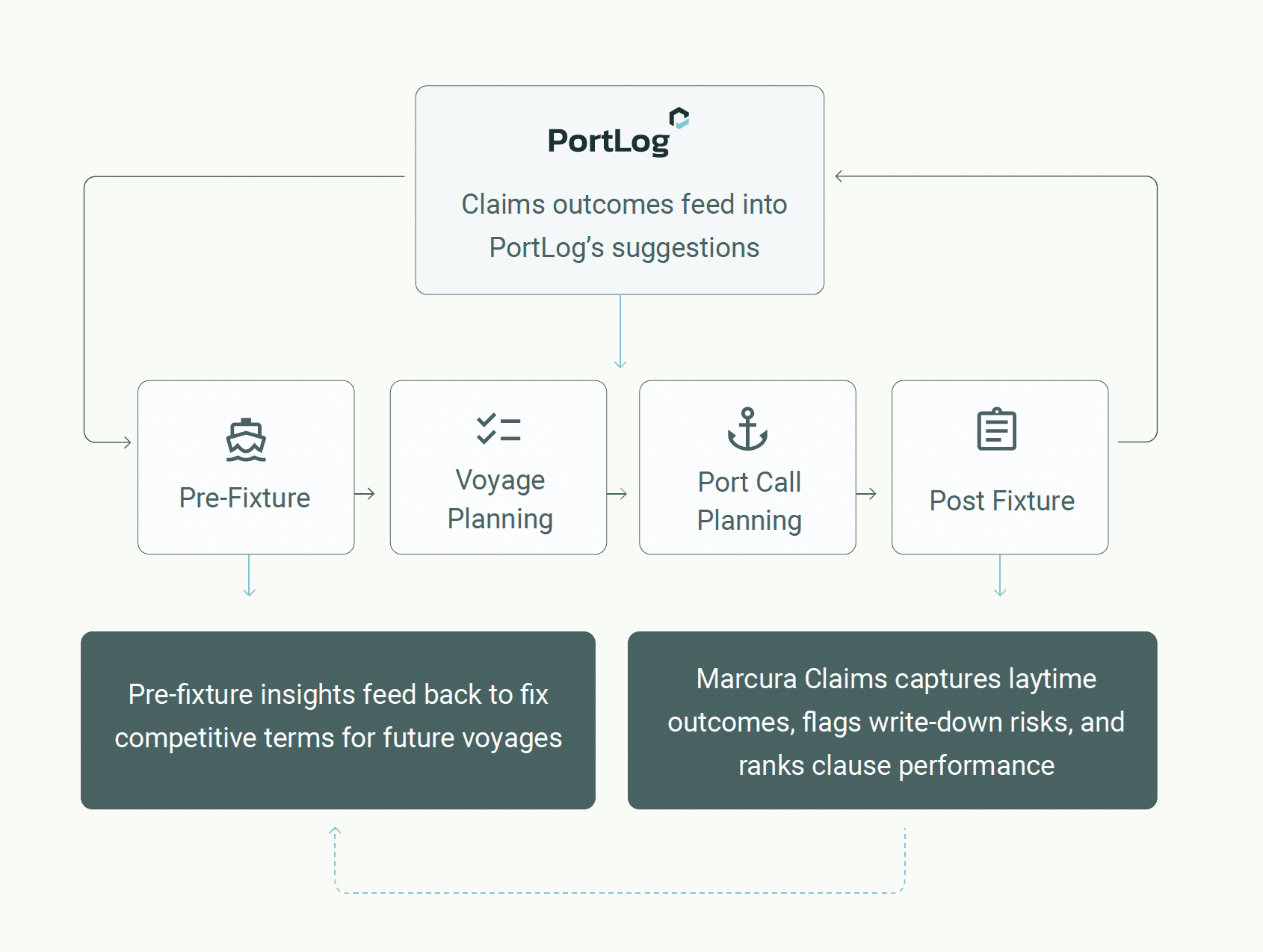
The further step is feeding claims outcomes forward into pre-fixture decisions in a 'learning loop'. Chartering teams use port performance data to estimate voyage costs and port costs.
If that data comes from actual structured claims outcomes rather than industry averages, the models get more accurate over time. Clause patterns inform the next fixture negotiation before it happens.
Kristian Helt, Director of Chartering at Pacific Basin, describes the shift: "Marcura Claims helped us move from manual processing to a streamlined, insight-driven model. It has directly improved our decision-making and operational efficiency."
The structural problem has a structural solution
Demurrage leakage isn't a capability problem. The process makes it difficult to capture everything, track every deadline, share institutional knowledge, and turn closed claims into something the business can use.
The path starts with the SOF. Capture every event, not just the ones that feed the current calculation. Build the data layer. The commercial intelligence follows from there.
Get your guide on how leading demurrage are turning their data into insights that drive commercial decisions
From claims processing to commercial intelligence
Read more
recent news

New guide
Take control of Procure-to-Pay
Why invoice control breaks down between PO and payment — and how leading ship managers close the gap. Free guide, plus two diagnostic tools.