了解港口,了解风险 更智能的预租决策 · PortLog网络研讨会 · 3月18日

了解港口,了解风险 更聪明的预先租船决策 · PortLog 网络研讨会 · 3月18日

Side View Of A Natural Gas Cargo Ships Travelling At The Sea With Container Ships In The Background.

We needed a partner that could understand our requirements and operations. Having worked with Marcura before on DA processing, it was clear they were the right fit.

Kristian Helt

Director (Chartering), Pacific Basin

Dry bulk vessels spend around 50% of their voyage duration in port, where unpaid time can quickly erode voyage profitability.

The cost of unpaid time is well understood. How accurately it's estimated before the voyage. Less so.

The unpaid time gap

Port time risk assessment often relies on standard factors like SHEX and turn time, overlooking unpaid time due to weather, holidays, documentation, etc.

Unpaid time averages 2.7 days per port call. Many operators budget 1.5 days.

That 1.2-day gap shows up in every voyage estimate as a silent drag on TCE. At average rates, it costs roughly $15,000 per port call, not as a one-off variance, but as a structural forecasting error that repeats across the portfolio.

Misjudging unpaid time also creates a false perception of despatch savings, TCE slippage that only becomes visible when actual port time is measured against the estimate.

Where the data sits

The information needed to close this gap already exists. It lives in the claims record.

Every laytime calculation captures actual port events: when laytime started, how long the vessel waited, which delays were excluded and why.

Structured and normalised across hundreds of port calls, that data is a precise record of what port time actually looks like at specific terminals, in specific seasons, under specific charter party terms.

The problem is that this information rarely reaches the people making the next fixture decision. Claims data stays with the claims team.

Voyage estimates rely on standard factors, SHEX assumptions, generic turn times, rules of thumb carried over from previous years.

The two datasets exist in parallel, never connecting.

Open magazines with a ship image and a book titled "Navigating New Financial Realities" on a surface.

Managing laytime claims in a volatile operating environment

Live Session: Disruption, Delay, Dollars: Mastering Laytime Claims explores how operators approach delays, documentation and disputes when voyages deviate from plan.

Pre-fixture: PortLog Pro

Marcura's approach links two platforms that address different parts of the voyage cycle, starting with PortLog Pro for pre-fixture port time intelligence.

PortLog Pro gives chartering teams visibility into what actually happens at individual terminals. This is data drawn from real port calls showing turnaround times, seasonal delay patterns, and the specific conditions that generate unpaid time at each location.

Teams using PortLog Pro consistently have reduced the forecasting error by around one day, adjusting estimates from 1.5 to 2.5 days against the 2.7-day average.

That improvement alone is worth approximately $15,000 per port call based on average TCE rates.

Terminal-level data also sharpens demurrage and despatch negotiations. Charterers can calibrate laytime terms against what actually happens at each port, rather than negotiating from standard assumptions.

Strategic adjustments guided by PortLog Pro’s data, such as increasing demurrage rates or reducing despatch incentives, can deliver median laytime improvements of around $2,000 per port call. 

Post-voyage: Marcura Claims

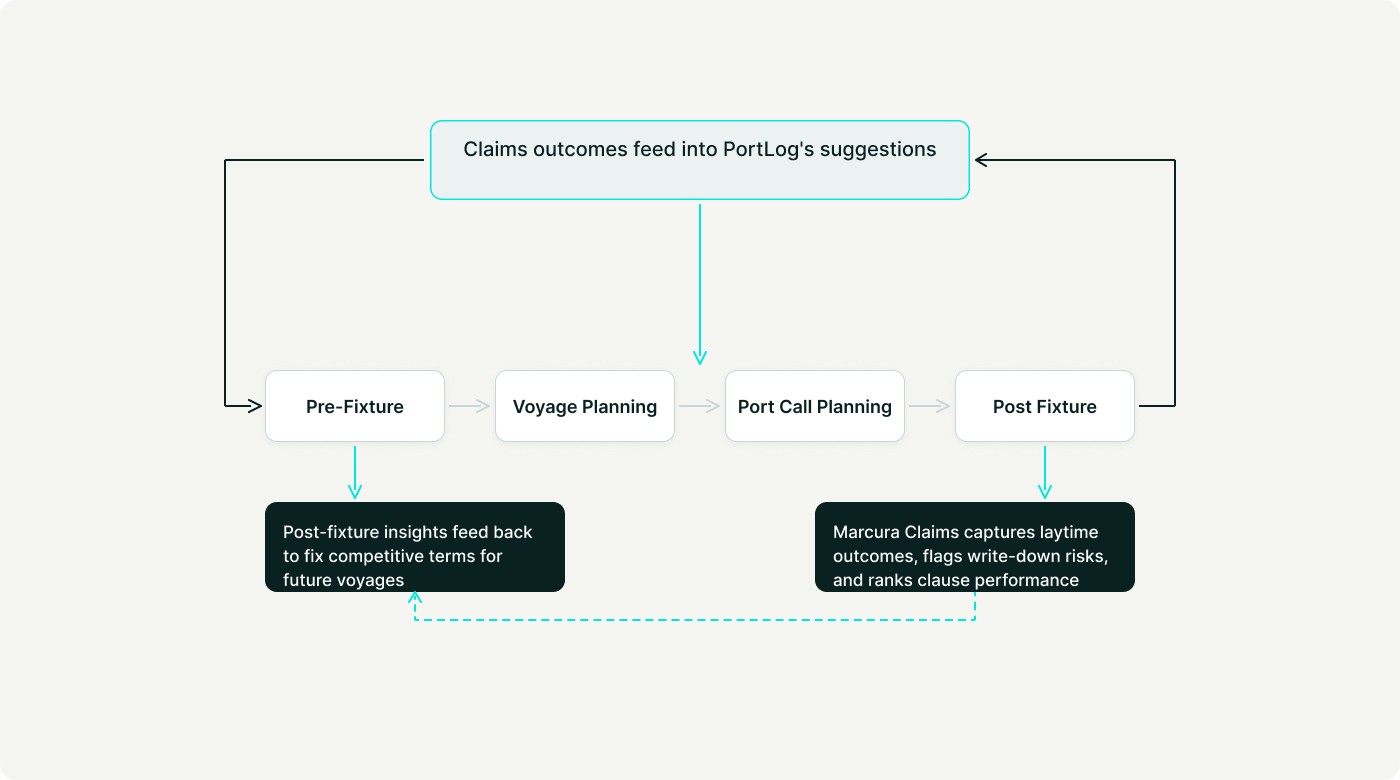
On the other side of the voyage, Marcura Claims structures and digitises the post-voyage record. SOFs are processed through an AI pipeline trained on more than 700,000 documents, then validated by a specialist QA team.

Every port event is captured and normalised to present the full operational picture.

That structured data surfaces patterns that would otherwise stay buried:

  • Which charter party clauses generate the most write-downs

  • which ambiguities recur across fixtures

  • Where demurrage value is being lost to contract language that could be tightened on renewal.

It also tracks frequently disputed laytime clauses and ranks them by financial impact, helping teams negotiate clearer, more robust terms over time. 

The learning loop

How your claims data feeds into future voyage forecasts

The real shift happens when these two datasets connect.

Deterministic outcomes from Marcura Claims — what actually happened at port, verified and structured — feed into PortLog Pro's forecasting models.

The next voyage estimate isn't built on assumptions. It's built on the documented reality of what that terminal, that trade route, and those charter party terms have historically produced.

Chartering teams get forecasts grounded in claims outcomes rather than industry rules of thumb. Operations teams get port stay projections that account for the delays and exclusions they'll actually encounter. And the claims team's work — traditionally locked in the post-voyage process — starts shaping commercial decisions it would otherwise never reach.

Even modest improvements compound across a portfolio. A 1% improvement in port time efficiency at scale represents millions of dollars annually in more accurate voyage economics, better cargo selection, and fewer voyages where the margin gets eaten by unforecasted port time.

Port time as a competitive advantage

The claims process has always produced data. The question is whether that data stays buried in the post-voyage record or feeds forward into the decisions that determine profitability on the next voyage.

Port time stops being an uncontrollable cost and starts becoming a source of competitive advantage, not because port conditions change, but because the team's ability to anticipate and price for them does.

Open magazines with a ship image and a book titled "Navigating New Financial Realities" on a surface.

Discover how Marcura combines AI with expert claims management to resolve laytime and demurrage disputes faster.

A smarter way to manage laytime and demurrage claims

Products

Solutions

Marcura AI

Resources

Careers

Products

Solutions

Marcura AI

Resources

Careers